
Three Centuries of Learning Beneath Mount Velebit
The history of education in Karlobag spans more than three centuries and reflects the changing fortunes of this coastal town beneath Mount Velebit. From the earliest forms of instruction associated with the Capuchin friars, through efforts to improve literacy and establish elementary schooling, to the construction of an imposing school building in 1875, education gradually became an increasingly important part of public life. The history of the school in Karlobag is therefore more than the story of a single institution: it also bears witness to the development of the town and successive generations of its inhabitants.
The Capuchins and the Beginnings of Education — 1710
At the beginning of the 18th century, the Capuchin friars played an important role in both the religious and everyday life of Karlobag. Alongside their pastoral work, their activities are associated with the earliest forms of instruction offered to the local population.
According to historical accounts, in 1710 the inhabitants of Karlobag petitioned the ruler to allow the Capuchins to continue teaching the townspeople. At a time when a developed system of public education did not yet exist, such instruction provided an important means of acquiring basic knowledge.
The foundations of the Capuchin monastery were laid that same year. During the 18th century, the monastery became one of the town’s recognisable centres of community life.
Literacy and Education in Karlobag — Pittoni’s Report of 1756
By the middle of the 18th century, Karlobag faced economic difficulties, poor transport connections and a shortage of educated people. Seeking a clearer understanding of conditions in the town, the Commercial Intendancy in Trieste commissioned Pittoni, an assessor based in Senj, to investigate local circumstances in 1756.
In his report of 12 March 1756, Pittoni described conditions in the town and drew attention to the shortage of literate and educated residents. There were no lawyers, legal representatives or notaries in Karlobag, while widespread illiteracy also hindered the work of the municipal administration.
Zlatko Herkov’s study of Pittoni’s report records that widespread illiteracy was linked to the lack of schools. Pittoni proposed bringing in members of a religious order to teach young people reading, writing and arithmetic. Education thus became part of wider efforts to develop Karlobag into a better-organised and economically stronger coastal town.
Source: Zlatko Herkov, Statut grada Karlobaga od godine 1757. [The Statute of the Town of Karlobag of 1757], 1976, pp. 84–85 (Pittoni’s report of 1756).
The Development of Elementary Education in the 18th and 19th Centuries
During the second half of the 18th century, efforts to improve literacy gradually became more organised. Historical scholarship mentions an elementary school in Bag as early as 1765; according to the school’s own historical account, a state elementary school was also operating by 1780. These references point to a gradual transition from earlier forms of instruction towards a more structured educational system.
The continuity of schooling in the 19th century is reflected in surviving records, including registers of orders issued by educational and military authorities between 1821 and 1856, and a book recording pupils’ distinctions maintained from 1827 to 1875. Such material offers insight into the school not merely as a building or institution, but as part of the everyday lives of pupils, teachers and local families.
The broader administrative background to these developments can be explored through the records of the commercial administration for Senj, Karlobag, Kraljevica and Bakar, dating from 1749 to 1776. Mirjana Peremin’s archival survey highlights the value of these records for studying economic and administrative conditions, and thus the wider setting in which education developed. The survey of this archival collection should not, however, be treated as direct evidence of the operation of any particular school.
Source: Mirjana Peremin, “Spisi komercijalne uprave za Senj, Karlobag, Kraljevicu i Bakar s posebnim osvrtom na fond ‘Commerciale’ (1749–1776)” [Records of the Commercial Administration for Senj, Karlobag, Kraljevica and Bakar, with Special Reference to the ‘Commerciale’ Collection], Arhivski vjesnik 36 (1993), pp. 207–221.
Teaching in Croatian and the New School Building — 1875
In the 1873/74 school year, Croatian replaced German as the language of instruction. This was an important change for the pupils and families of Karlobag, bringing classroom teaching closer to the language spoken in their homes.
The construction of a new school building in 1875 marked a major turning point in the development of education in Karlobag. Built on a prominent site beside the sea, the school was not simply a place for lessons: it was also a visible expression of the town’s modernisation and the growing importance of public education. Its construction is associated with the support of Baron Anton Mollinary and the provincial authorities of the time.
Mollinary’s name remained closely connected with the history of Karlobag. In 1878, a bust in his honour, created by the sculptor Ivan Rendić, was erected in the town.
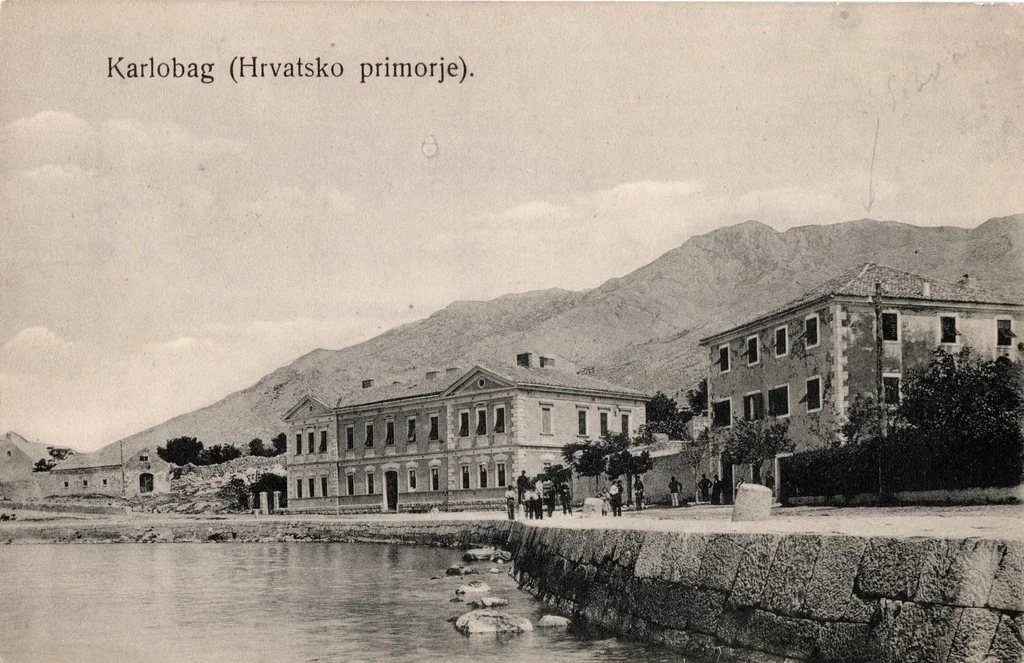
A black-and-white postcard provides valuable evidence of Karlobag’s appearance in the early 20th century, with the school building occupying a particularly prominent place. Its monumental façade, regular rows of windows and emphasised central section reflect the importance education had acquired in the town’s development. Standing immediately beside the sea, beneath the slopes of Mount Velebit, the school became one of the defining landmarks of Karlobag at that time. More than a picturesque view, the postcard preserves a visual record of an era in which the school building symbolised education, progress and the town’s social life.
Repairs to the School Building — 1929
More than half a century after its construction, the school building still occupied a prominent place in the life of Karlobag. Surviving official correspondence from the Construction and Technical Sections in Gospić, dating from 1929, reveals how repairs to the state civic school were being prepared during the interwar period.
The earliest surviving documents are dated 11 January 1929, when the Construction Section in Gospić requested the publication of a notice inviting bids at a public tender. The estimated cost of the proposed works was 35,000 dinars. Bidders were required to provide a deposit of 3,500 dinars and the prescribed documentation. These records show how investment in the school building was being planned.
In October of the same year, a further tendering procedure was prepared for authorised repairs to the state civic school. A notice issued by the Technical Section in Gospić on 3 October 1929 gave an estimated cost of 12,500 dinars and required a deposit of 1,500 dinars. The tender was scheduled to take place on 25 October at the Section’s offices in Gospić.
The January and October records are valuable evidence of public efforts to maintain a school building that had symbolised Karlobag’s educational and social progress since 1875. They also provide insight into administrative procedures, cost estimates and tender conditions. As these documents consist of tender notices and official correspondence, they do not in themselves establish which repairs were ultimately carried out.
Source: State Archives in Rijeka, HR-DARI-56, Box 44; Construction Section in Gospić, no. 89/1929 (11 January 1929), and Technical Section in Gospić, no. 1959 (3 October 1929).
The School from the Second World War to the Present Day
The Second World War disrupted everyday life in Karlobag and at its school. According to the school’s published history, during the Italian occupation the building was also used to stable the horses belonging to Italian officers.
After the war, school life resumed under changed social circumstances. For part of the post-war period, the institution was known as “Divko Budak” Elementary School; today it operates as Šime Starčević Elementary School. Changes in the school’s name and organisation reflect the different historical periods through which Karlobag has passed.
From the earliest teaching associated with the Capuchins to today’s elementary school, the history of education in Karlobag connects generations of pupils, teachers and families. The school building erected in 1875 remains an enduring feature of the townscape and a powerful reminder of the place education has held in Karlobag’s development.
Chronology
| Date | Event |
|---|---|
| 1710 | According to local historical accounts, residents petitioned for the continuation of Capuchin teaching; the original document is still being sought. |
| 12 February 1756 | An order was issued to investigate conditions in Karlobag; Pittoni’s report followed. |
| 12 March 1756 | Pittoni submitted his report, drawing attention to widespread illiteracy and the need to educate young people. |
| 1765 | An elementary school in Bag is recorded in scholarly literature. |
| By 1780 | According to the school’s history, a state elementary school had been established. |
| 1821–1856 | Register of orders issued by educational and military authorities. |
| 1827–1875 | Book recording pupils’ distinctions. |
| 1873/74 | Croatian replaced German as the language of instruction. |
| 1875 | Construction of the present school building. |
| Early 20th century | Historic postcards show the school building on the Karlobag waterfront. |
| 1929 | Two documented tenders for repairs to the civic school. |
| 1940s | Wartime changes in the use of the school building. |
| After 1945 | Post-war development of education; the school bore the name “Divko Budak” for part of this period. |
| Today | Šime Starčević Elementary School. |