Few figures in Karlobag’s history left as deep and lasting a mark as General Anton Mollinary. Although not a native of Karlobag, this high-ranking officer of the Habsburg Monarchy recognized the importance of the town and the needs of its inhabitants. Through his influence, vision, and personal commitment, he gave a strong impetus to the development of the place, which is why the local population considered him their greatest benefactor during his lifetime.
Through his efforts, road links between Karlobag and Senj were improved, a new waterfront and promenade were built, and a civic upper primary school was opened. These projects laid important foundations for the town’s economic, transport and social development. Mollinary was more than a military commander: he understood that a community’s future depended on investment in infrastructure and education.
The people of Karlobag expressed their gratitude in an exceptional way. The municipal council decided to erect a public monument to Mollinary during his lifetime—a rare distinction that shows the esteem in which he was held by his contemporaries.
Mollinary’s Reputation before the Karlobag Bust
Several years before Ivan Rendić created his portrait bust, Baron Anton Mollinary already enjoyed considerable military and social prestige. This is also reflected in Monographie von Syrmien, published in 1873 in Semlin (Zemun), which its author, Dr Bartholomäus E. Godra, dedicated to Mollinary.
ANTON FREIHERR MOLLINARY
von Monte Pastello
On the dedication page, Mollinary is named in full together with a series of honours, decorations and military appointments. Among other distinctions, he is identified as a Field Marshal-Lieutenant, proprietor of the 38th Line Infantry Regiment and Commanding General in Zagreb. The author dedicated the work to him “with the deepest respect.”
Source: Monographie von Syrmien, Semlin (Zemun), 1873.
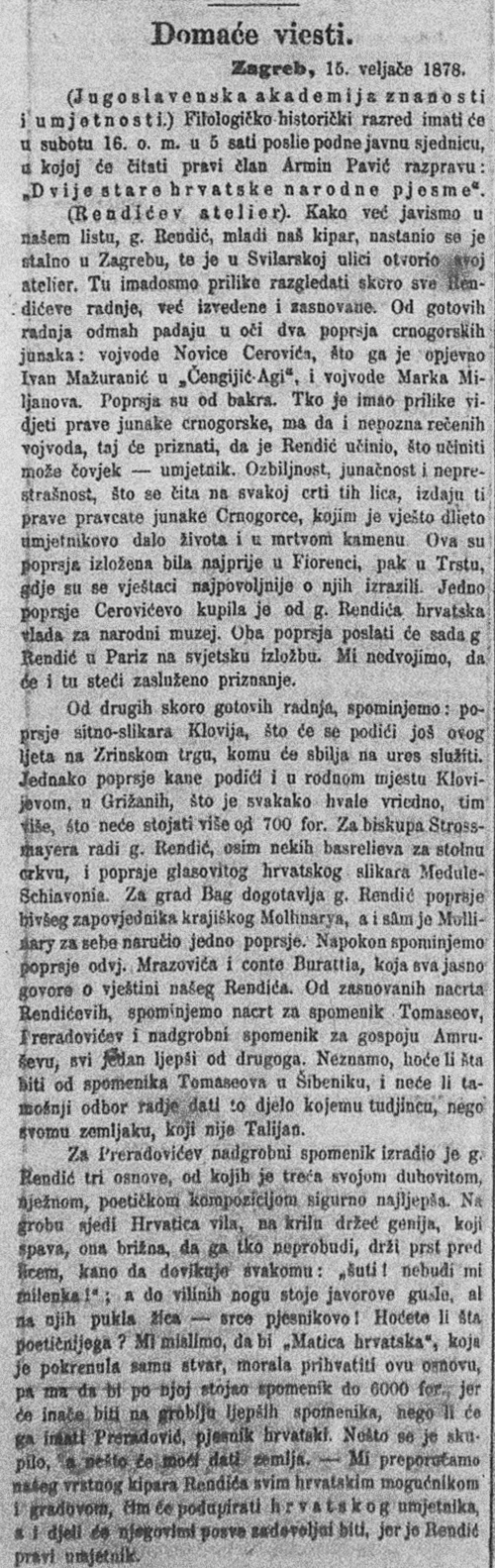
This dedication from 1873 offers an interesting glimpse into the position and esteem Mollinary enjoyed only a few years before the events that would connect him with Karlobag. In 1877, the commission for the Karlobag monument was formally established, and the task of creating Mollinary’s portrait bust was entrusted to the young Ivan Rendić.
The Story of General Anton Mollinary’s Bust
In 1876, Karlobag decided to commemorate permanently the man to whom it owed much of its development. The commission for the bust was entrusted to the young but already highly talented sculptor Ivan Rendić , who would later become one of the most important Croatian sculptors of the nineteenth century. The creation of the monument is documented by numerous archival sources and by Rendić’s correspondence preserved in the Fine Arts Gallery in Split, the Ivan Rendić Gallery in Supetar, and the Glyptotheque of the Croatian Academy of Sciences and Arts in Zagreb.
The formal basis of the commission was established in June 1877, when Rendić travelled to Karlobag (then commonly referred to as Bag) and concluded a contract for the monument. This is confirmed by his letters to Mrazović preserved in the Glyptotheque Archive in Zagreb.
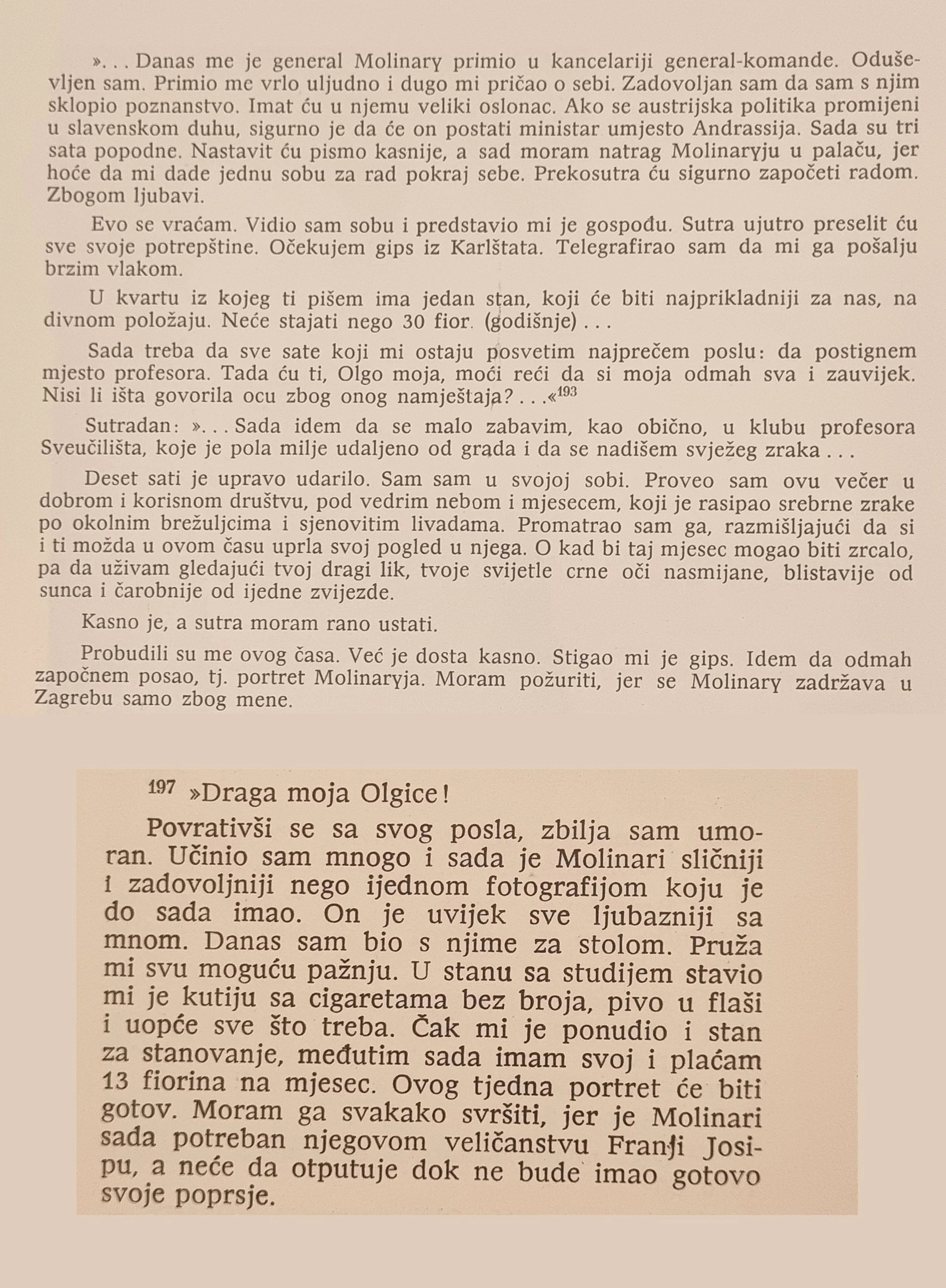
As part of the project, Rendić soon portrayed General Anton Mollinary during the general’s stay in Zagreb. Work on the bust developed into a genuine friendship between the young artist and the experienced commander. Their relationship is vividly reflected in Rendić’s letters to his fiancée Olga, in which he describes the general’s hospitality. Mollinary welcomed him into his home, tried to assist him in every way, and even postponed a journey to Vienna until the portrait was completed.
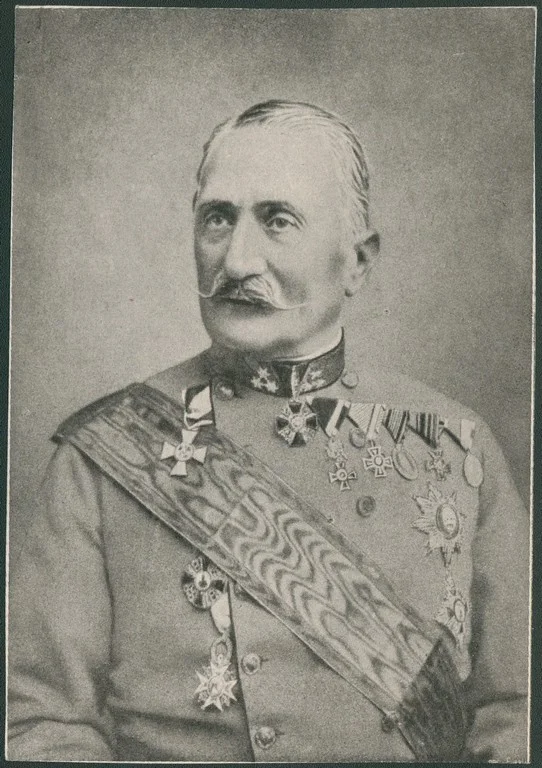
Baron Anton Mollinary, Zagreb, 1877.
The photograph was taken in Zagreb in 1877, the same year in which the contract with Ivan Rendić for the creation of Mollinary’s monument was concluded in Karlobag. It is not known whether Rendić used this photograph as a reference when creating the bust, but the coincidence of its place and time makes it a particularly interesting document in the context of the portrait’s creation.
Source: State Archives in Zagreb, Zagreb.
In one of his letters, Rendić wrote:
„Mollinary is more like himself and more satisfied than with any photograph he has had so far. He is always kinder and kinder to me...“
These simple words reveal the trust and mutual respect that developed during work on the sculpture. The resulting bust was more than a faithful portrait of a distinguished general: it became a lasting symbol of Karlobag’s gratitude to a man whose work had profoundly benefited the town and its inhabitants.
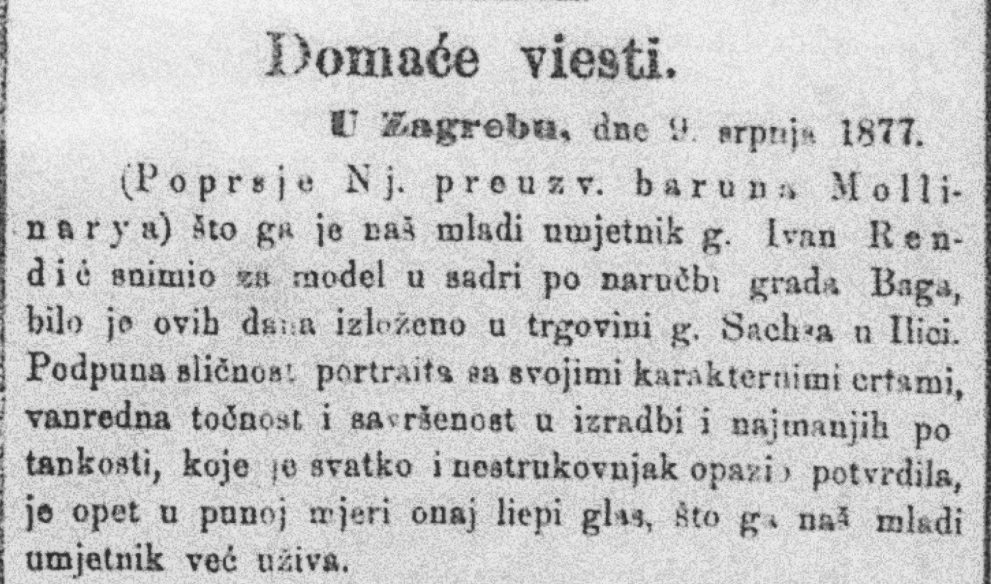
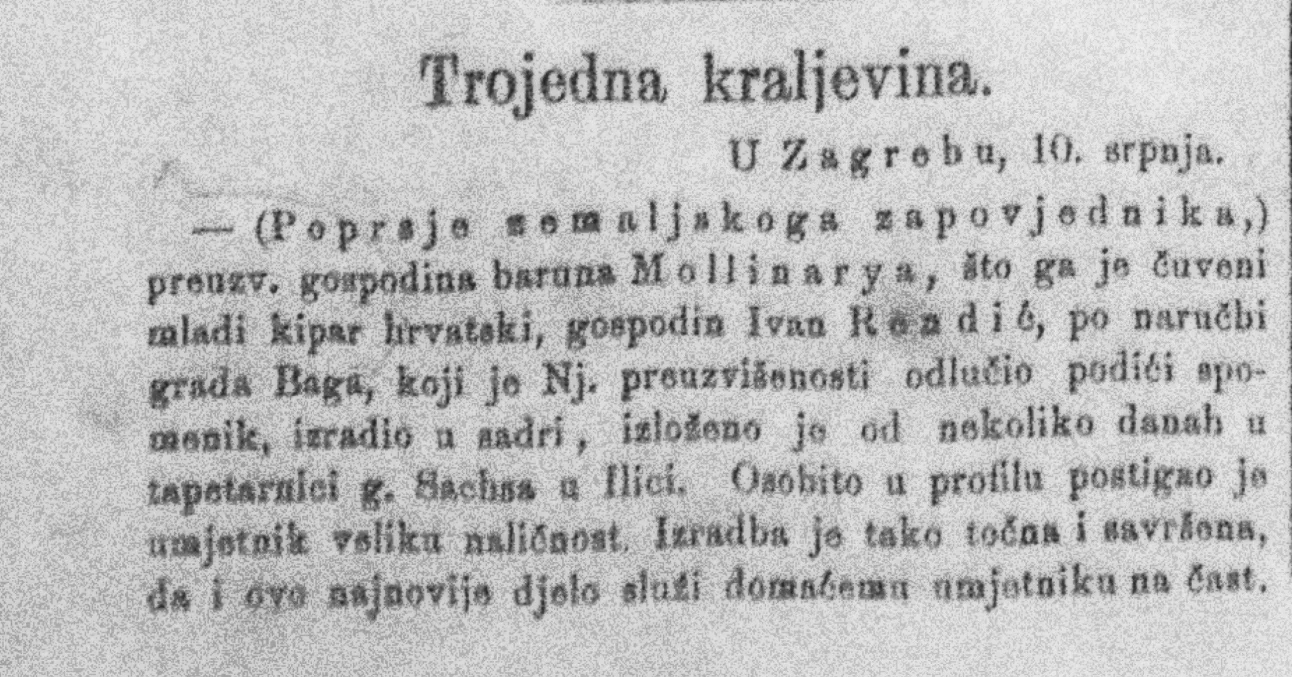
When the plaster bust was exhibited in Sachsa’s shop on Ilica Street in Zagreb in the summer of 1877, it attracted considerable public interest. Narodne novine (10 July 1877) and Obzor (9 July 1877) noted that the likeness was so faithful and the execution so successful that it did credit to the Croatian artist.
The permanent monument then entered its final phase. In July of the same year, Rendić sent the model to Manuzio, his stonecutter in Florence. Following Rendić’s instructions, the marble bust was to be executed at twice the scale of the model. Manuzio carved it from high-quality marble for 350 francs, after which Rendić travelled to Italy to complete the final artistic work himself.
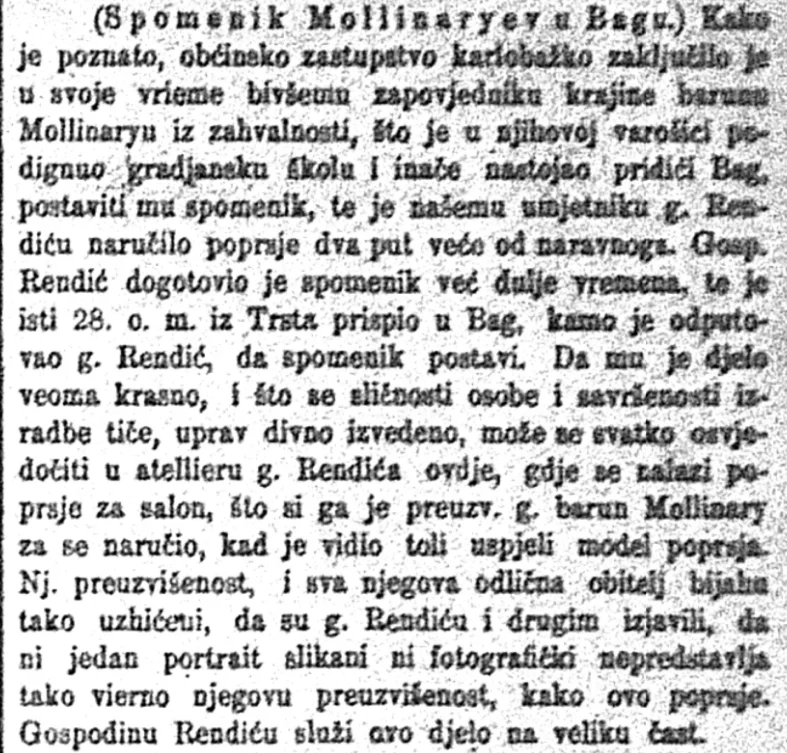
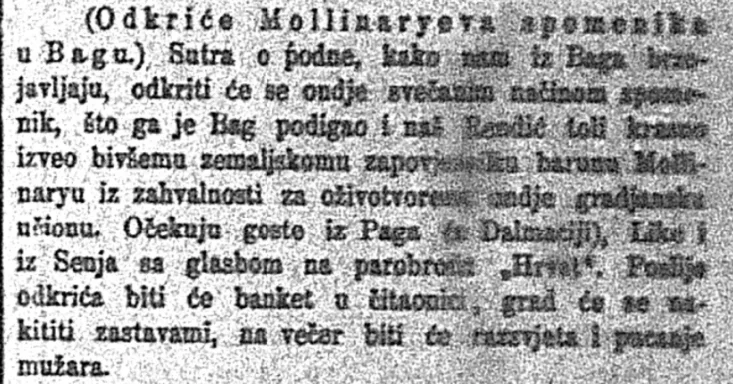
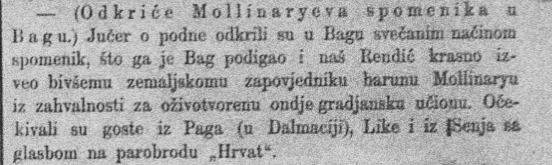
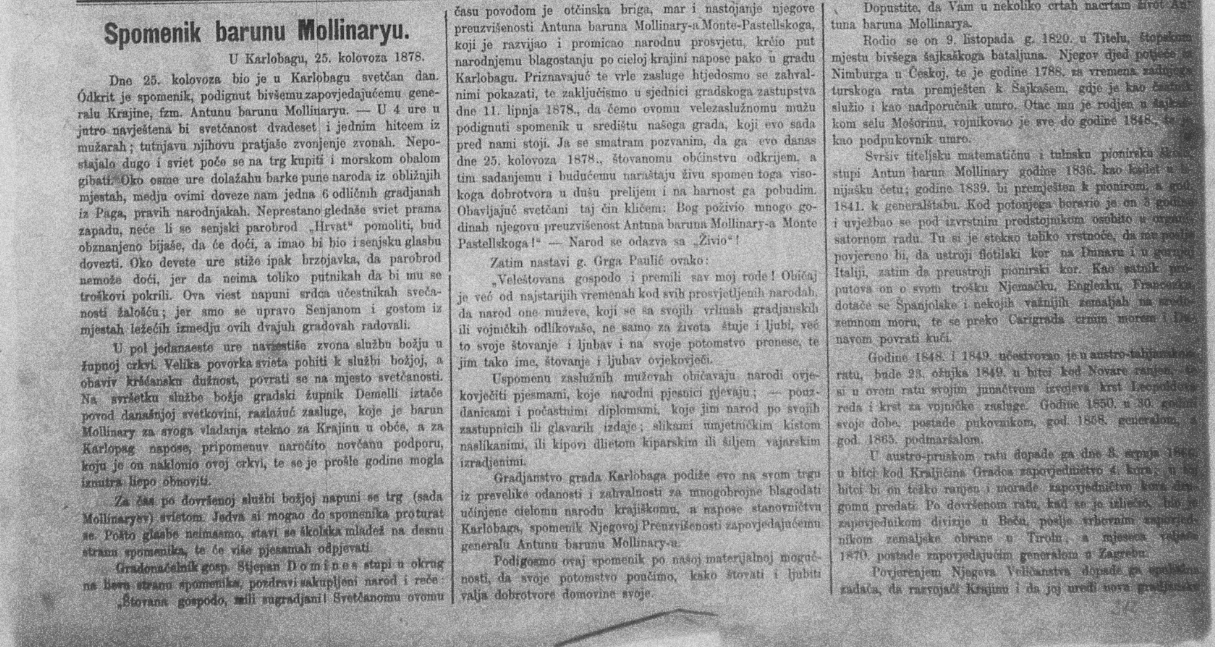
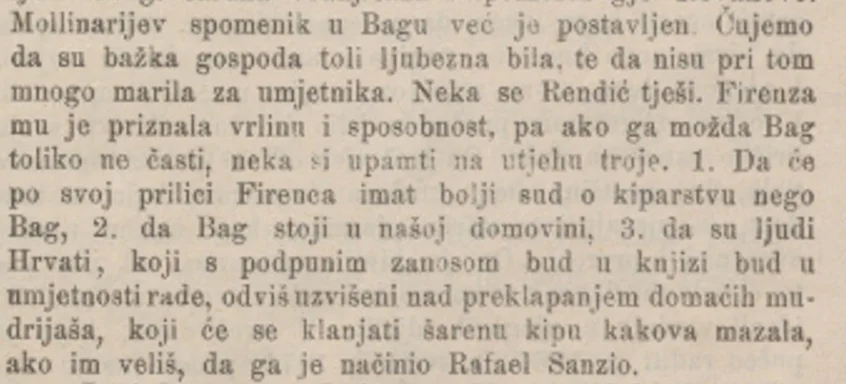
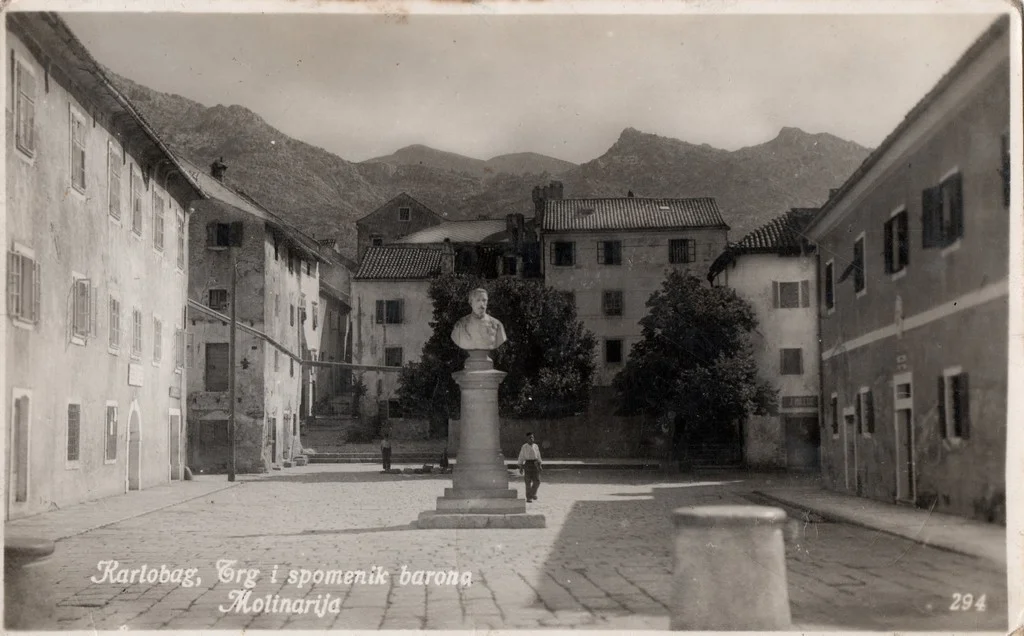
The project culminated in August 1878. The one-metre-high marble bust was placed on a 2.2-metre stone pedestal in Karlobag’s main square. It was ceremonially unveiled on 25 August 1878 with speeches, songs performed by schoolchildren, a formal banquet and toasts in General Mollinary’s honour, all of which were widely reported in the press. August Šenoa, however, recorded an intriguing detail in Vienac (Nov. 2, 1878, p. 711) , noting that the people of Karlobag were initially not especially enthusiastic about the monument’s appearance.
Pleased with Rendić’s work, General Mollinary also ordered a smaller marble copy for his private collection, made to the dimensions of the original plaster model. It was produced in Rendić’s studio, but its later fate is unknown.
The public monument in Karlobag’s square also failed to survive. It was destroyed during the Second World War, and its surviving fragments were never officially recovered. Local tradition holds that the head of the bust was broken from the pedestal and thrown into the sea behind the breakwater, where all trace of it was subsequently lost.
Although both the public monument and the general’s private marble bust have disappeared, their memory survives in Rendić’s letters, contemporary newspaper reports, old photographs and postcards. Of particular importance is a photograph of the original plaster model, preserved in the first album of Rendić’s works in the Glyptotheque of the Croatian Academy of Sciences and Arts in Zagreb. It remains one of the most reliable surviving visual records of a monument that once held an important place in Karlobag’s history.
Source: T. Potočnjak Collection / Inv. No. ZTP-KB-1123