The Kubus at Stara Vrata and the Road Linking the Sea and the Mountains
At the pass where Velebit, Lika and the Adriatic meet, the road becomes part of both the landscape and its history.
In the mid-19th century, during a period of major infrastructure development in the Habsburg Monarchy, one of the most ambitious and important roads in the Croatian lands was built: the Gospić–Karlobag road across Velebit. In 1840, Josip Kajetan Knežić, a distinguished officer of the Military Frontier and an accomplished road engineer, was commissioned to design and construct a new 41-kilometre mountain road linking the Lika hinterland with the Adriatic. Surveying and design work took place between 1841 and 1843, with the assistance of his principal associate, Military Frontier lieutenant Simo Kekić.
Construction began in 1844 on the Gospić–Brušane–Oštarije section and continued until 1846, while Kekić completed the stretch from Baške Oštarije to Karlobag. The road was laid out with long, even and gentle gradients of no more than 5 per cent, making it remarkably advanced even by modern standards. Its carriageway was up to six metres wide and was reinforced with massive kerbstones, dry-stone retaining walls built from large blocks, and a carefully designed drainage system. Contemporaries regarded Knežić’s road as a masterpiece, comparable with his earlier achievements, the Josephina and the Majstorska Road.
"Ferdinandus I. Austrijski imperator MDCCCXLVI"
"Der kulminations punchtdes neuen Carlobagenen Strassen zuges an der Sudlichen Grenzedes Velebit Gebirges bei Stara vrata ist uber der Adriatischen Meeres flasche Wiener fur erhaben"
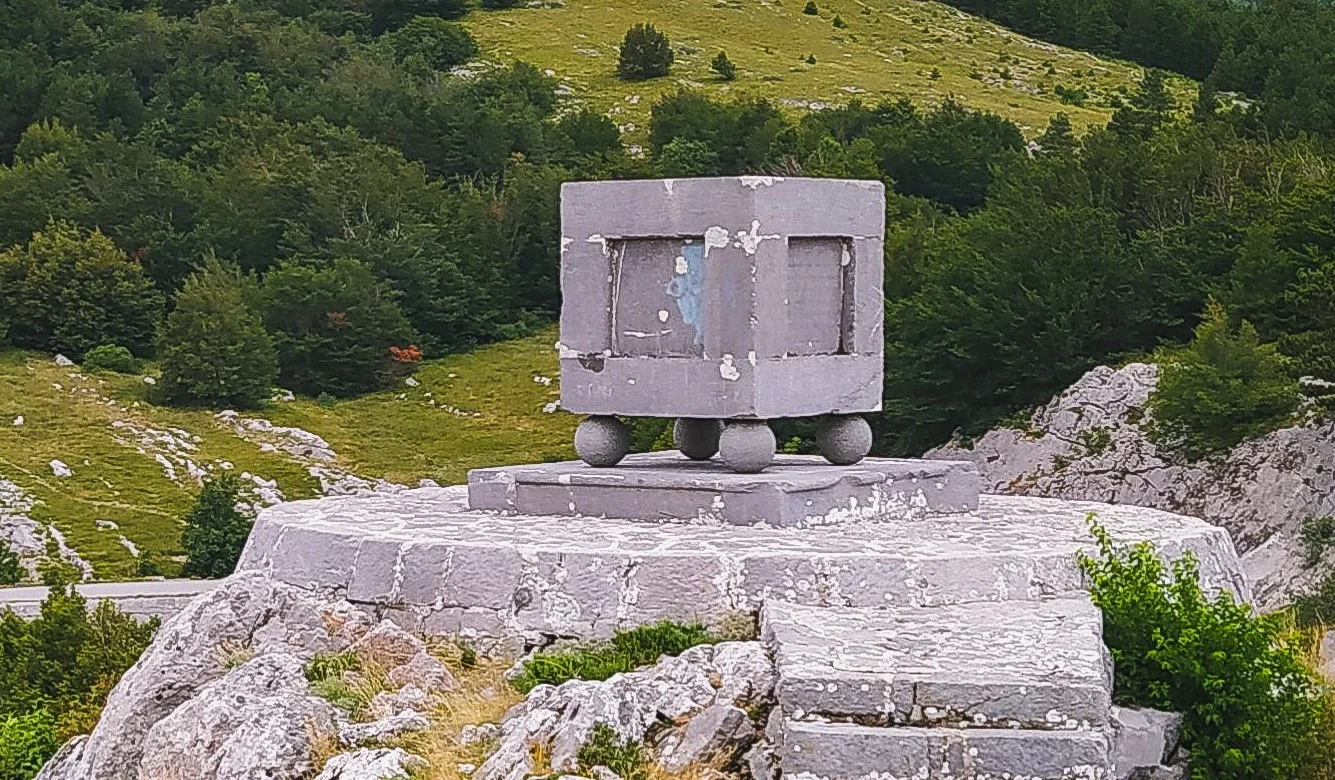
At the highest point of the new Karlobag road, at the Stara Vrata, or Vela Vrata, pass, Knežić erected the stone monument known as the “Kubus”, which local people also call the “Ura”. Erected in 1846, the Kubus was not a measuring instrument, but a monumental marker commemorating the completion of the road and identifying its highest point. Designed as a stone cube resting on four stone spheres and approached by a staircase of 33 steps, it bears a German inscription marking the road’s highest point on the southern edge of Velebit at Stara Vrata.
The inscription records the elevation in Viennese feet (Wiener Fuß), the Monarchy’s official unit of measurement at the time, reflecting the administrative and technical precision of its engineering system. The Kubus stands at approximately 869 metres above sea level, with sweeping views towards Karlobag, the island of Pag and the Adriatic, as well as inland across Lika. Here, where mountain and coast meet, the monument symbolically unites the two worlds that the new road permanently connected. Like the fountain at the Ljubica spring in Baške Oštarije, built by Knežić in 1845, the Kubus was conceived as an enduring monument to human engineering achievement in a rugged mountain landscape.
Josip Kajetan Knežić did not live to see the road to Karlobag fully completed. He died in Senj in 1848, worn down by decades of work across the demanding terrain of Lika and Velebit. His legacy, however, remains permanently inscribed in the landscape. The Gospić–Karlobag road and the stone Kubus at Stara Vrata are rare and valuable witnesses to an era in which engineering expertise, state ambition and the natural environment came together in a remarkable whole. They tell not only the story of transport, but also one of perseverance, careful planning and the long history of linking the Adriatic coast with the hinterland.
Major Road-Building Projects Across Velebit
The history of crossing Velebit reflects generations of earlier efforts to connect Lika with the Adriatic.
Ancient Roman Road
The earliest known engineered route linking the ancient settlement of Vegium with the hinterland. Roman builders were among the first to recognise the importance of the Baške Oštarije pass as a favourable route to the sea.

Theresiana (1786–1789)
Built by Filip Vukasović. After its completion, Emperor Joseph II proclaimed Karlobag a free port town, strengthening its regional importance as a harbour.
Karolina Road (1726)
Designed by Antun Matija Weiss. One of the Habsburg Monarchy’s earliest major road-building projects, it demonstrated that difficult mountain terrain could be conquered by a modern engineered road.
Majstorska Road (1832)
Knežić’s masterpiece across Tulove grede. The road established his reputation as a leading road engineer and gave him the experience he would later apply to the route towards Karlobag.
“All these projects shared the same goal: to break Lika’s transport isolation and allow Karlobag to flourish as a port open to the Adriatic.”