 © DHM of Karlobag
Karlobag is a picturesque coastal town nestled beneath the southern slopes of Velebit, where continental and Mediterranean climates meet. Its strategic position and natural setting made it an important port, trading centre and military stronghold for centuries.
Karlobag’s history reaches far into the past. The Roman settlement known as Vegium was of military, transport and commercial importance and survived until the 4th or 5th century, when its inhabitants abandoned it in the face of Gothic incursions and fled to the island of Pag. Although the settlement itself was deserted, its name endured and, through its resemblance to the island’s name, evolved into Bag. During the reign of the Croatian king Zvonimir, the area belonged to a coastal district within the Diocese of Rab. In 1251, Bag was recorded under the name Scrissa and belonged to the old Croatian Tugomirić lineage. The Kurjaković princes of Krbava, who controlled almost the entire Velebit Channel, took possession of Bag in 1322, and on 2 November 1387 granted the town municipal privileges.
15th and 16th Centuries
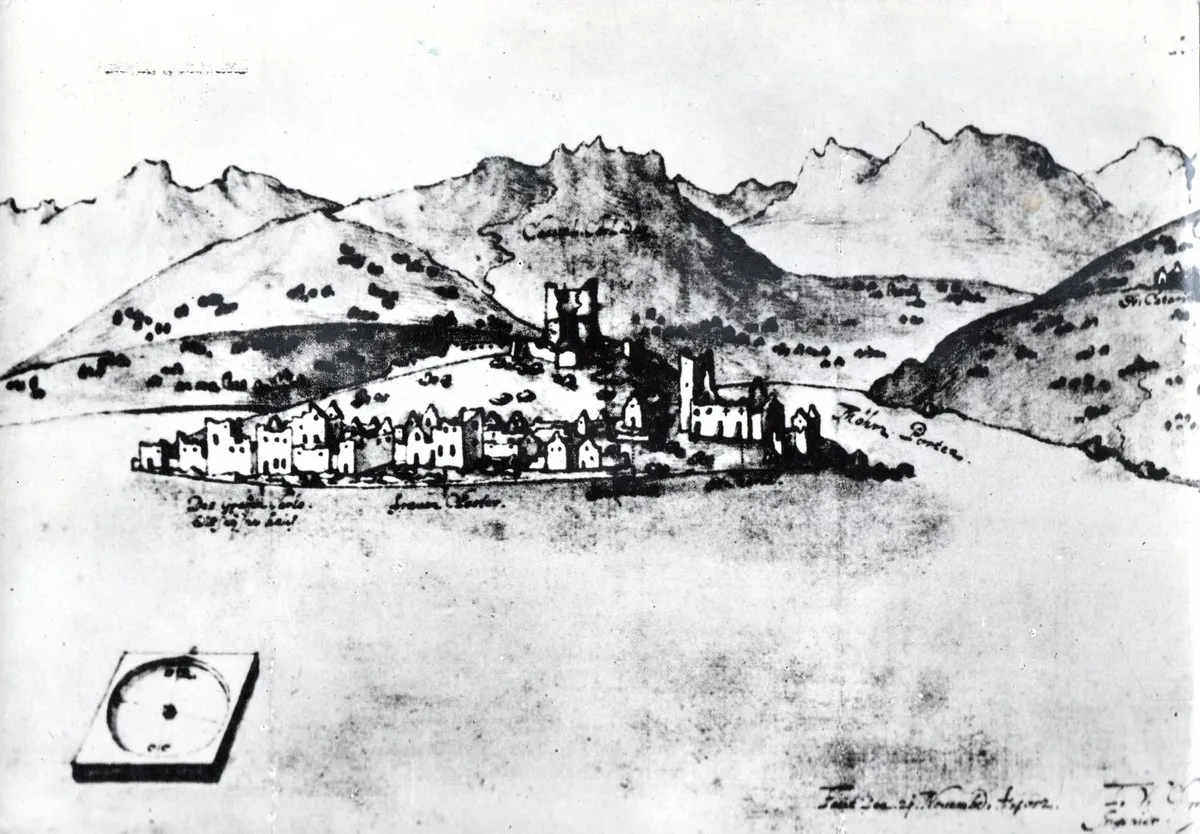
In the 1470s, Bag came under the rule of King Matthias Corvinus and remained in his possession until 1493, when it passed to Ivan Karlović of Krbava. The Ottomans attacked Bag in 1525, devastating and burning the town and either driving out its inhabitants or carrying them into captivity. Reconstruction began in 1574, and in 1580 the town was recorded for the first time as Karlobag, a name that points to Archduke Charles and his role in its restoration.
17th and 18th Centuries
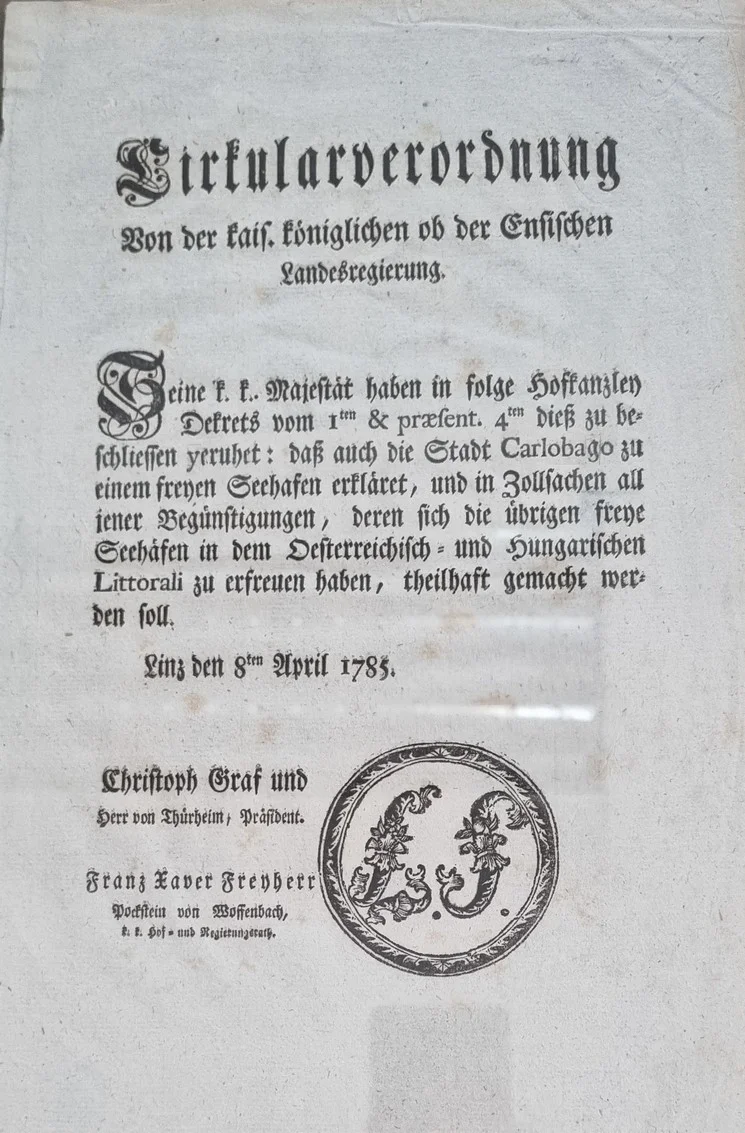
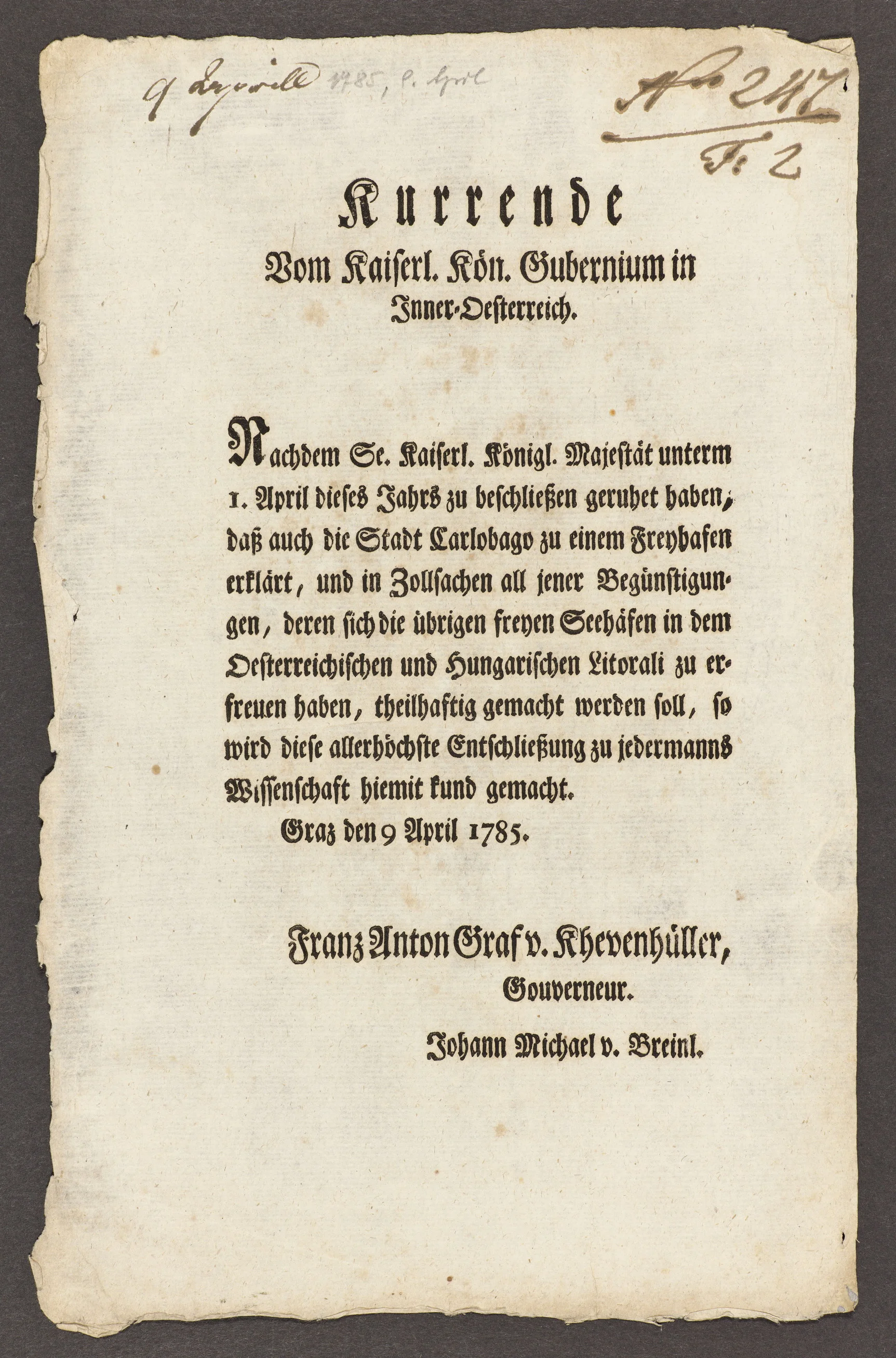
In 1683, Jerko Rukavina of Ražanac, together with Dujam Kovačević of Vinjerac, brought a group of Bunjevci Croats to Bag, present-day Karlobag. A few years later, in 1686, they led the Bunjevci into Lika, crossing the Baška Vrata pass and settling them in four villages: Brušane, Trnovac, Smiljan and Bužim. After Lika was liberated from Ottoman rule, Karlobag came under Austrian authority. The town was further fortified, and a Capuchin monastery and church were built in 1710. In 1757 Karlobag received its Statute, thereby acquiring the status of a town, while in 1785 Emperor Joseph II, son of Maria Theresa, granted it the status of a free port and the process of its separation from the Military Frontier began.
© DHM of Karlobag
Source: Karlobag Municipality Archives.
 © DHM of Karlobag
Circular Proclaiming Karlobag a Free Port, 1785 – Graz
Source: Austrian National Library (ÖNB), Vienna.
19th and 20th Centuries
From 1809 Karlobag was under French rule, before being returned to Austria in 1814.
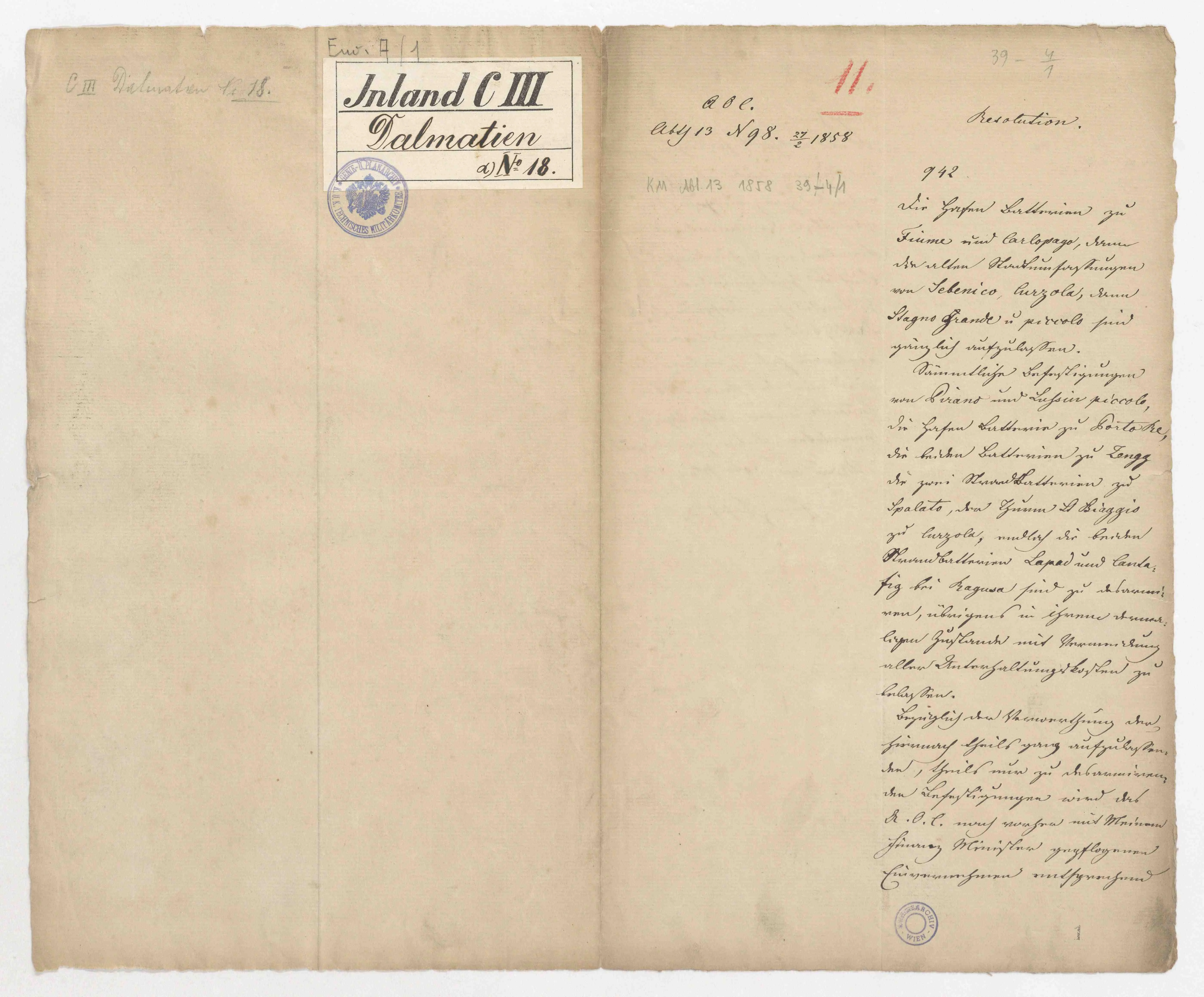
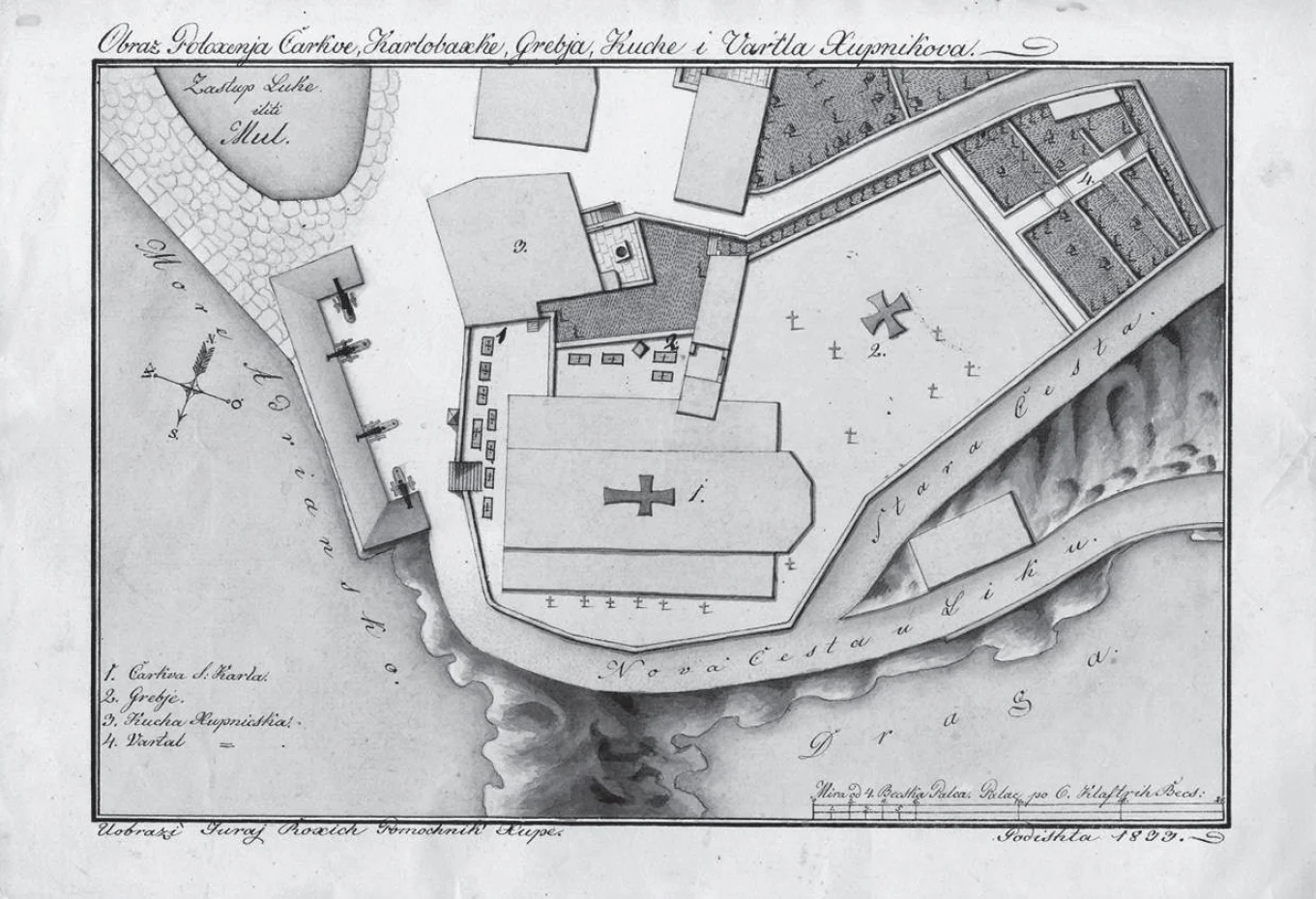
In the mid-19th century, specifically in 1858, Austrian Imperial Resolution No. 742 ordered the complete abandonment of Karlobag’s harbour battery, the artillery position that had defended the town. With this decision, Karlobag lost much of its former direct importance as a fortified military site. The battery stood in front of the Church of St Charles Borromeo, as shown in the illustration below.
 © DHM of Karlobag
Imperial Resolution No. 742, 1858
Source: Austrian State Archives, Vienna.
 © DHM of Karlobag
Church of St Charles Borromeo and the Harbour Battery
Source: Mile Bogović, The Church in the Velebit Podgorje Region: Past and Present.
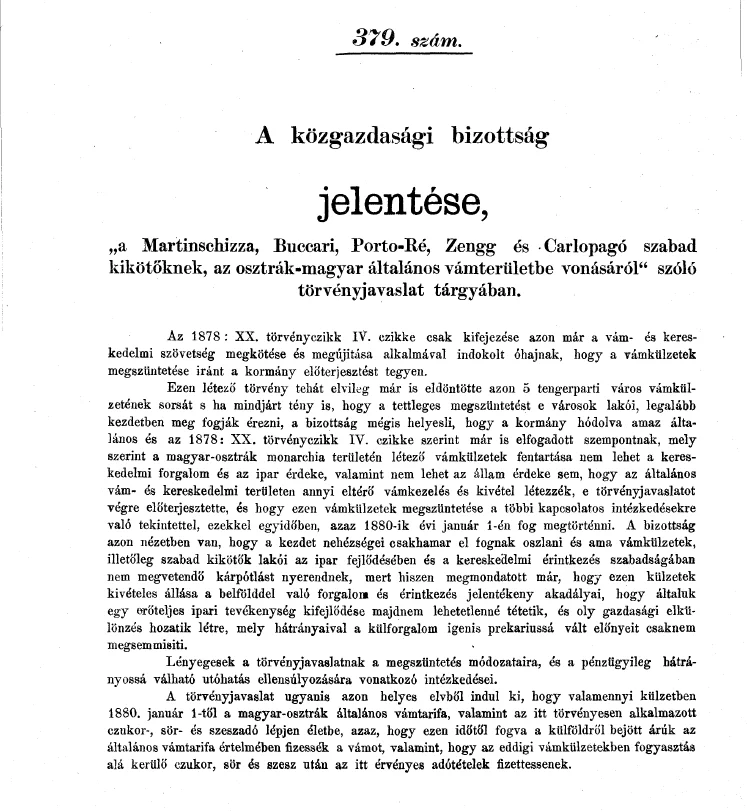
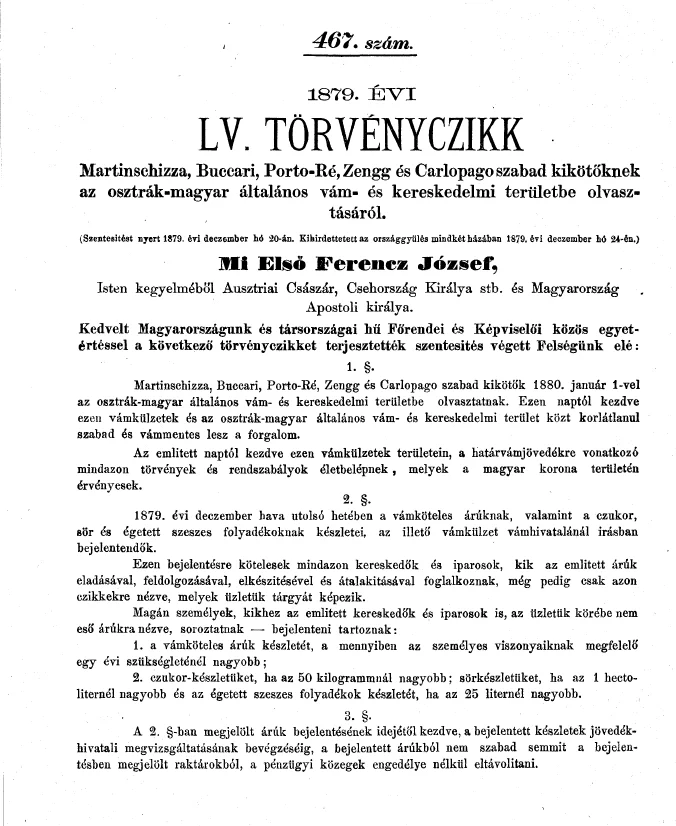
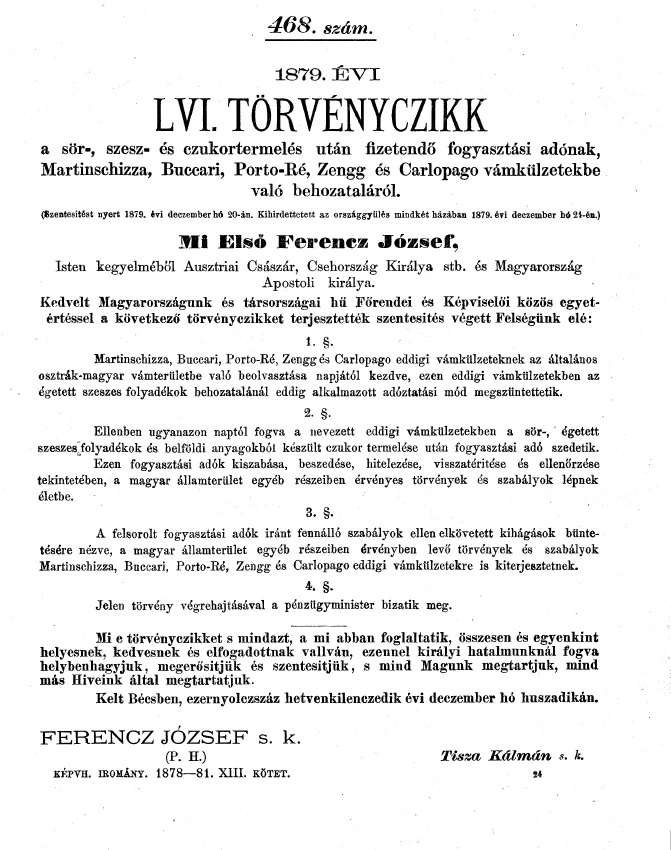
In 1879, the Hungarian Parliament dealt directly with the termination of the special customs status enjoyed by Karlobag and several other free ports. The parliamentary report was followed by the final Act LV of 1879, which incorporated Karlobag into the general Austro-Hungarian customs and commercial territory from 1 January 1880. A companion Act LVI regulated the consumption taxation of beer, spirits and sugar in the former customs enclaves.
 © DHM of Karlobag
Parliamentary Report No. 379, 1879
 © DHM of Karlobag
Final Act LV of 1879 – No. 467
 © DHM of Karlobag
Act LVI of 1879 – Taxes on Beer, Spirits and Sugar
The legislative process during November and December 1879 shows that the abolition of Karlobag’s special status was not merely a formal change. The report of the Economic Committee dated 12 November explained that the customs separation hindered traffic with the interior and the development of industry, while the legislation determined that Karlobag and the other named free ports were to be incorporated into the common Austro-Hungarian customs and commercial territory from 1 January 1880.
The change directly affected everyday economic life. During the last week of December 1879, merchants and tradesmen were required to declare to the customs office their stocks of goods liable to customs duty, as well as specified quantities of sugar, beer and distilled alcoholic beverages. By the separate Act LVI of 1879, the system of consumption taxes on sugar, beer and alcoholic beverages that applied in the rest of the Hungarian part of the Monarchy was extended to the former customs enclaves, including Karlobag.
The Act that ended Karlobag’s special customs status was sanctioned on 20 December 1879 and promulgated before both Houses of Parliament on 24 December 1879. When it entered into force on 1 January 1880, almost 95 years of Karlobag’s history as a free port came to an end, from the privilege granted in 1785 to the town’s incorporation into the Monarchy’s general customs system.
This process culminated in 1881 with the abolition of the Military Frontier, after which Karlobag passed under civil administration. Under the 1886 Act on the Organisation of Counties, Lika-Krbava County was established with its seat in Gospić, holding its first session on 22 November of that year. Karlobag then became part of the Gospić district, within one of Croatia’s largest counties by area, comprising nine districts: Gospić, Otočac, Donji Lapac, Korenica, Perušić, Udbina, Gračac, Brinje and Senj.
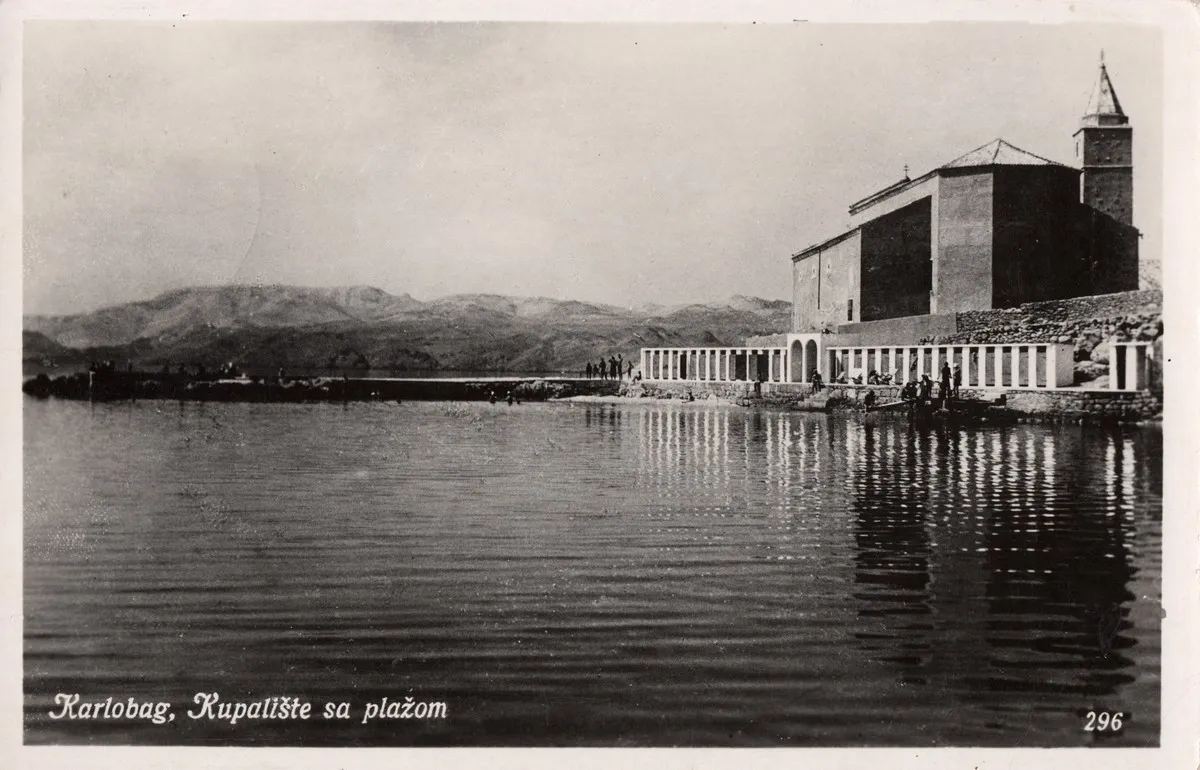
In 1894, Karlobag’s harbour, breakwater and landing quay were improved, and a steamship called there daily. The forestry administration building was constructed around this period, while the primary school had been built in 1875. During the First World War the town was ravaged by the Spanish flu, and the creation of the Kingdom of Serbs, Croats and Slovenes in 1918 brought further economic hardship. Seeking a new path through tourism, Karlobag built a municipal bathing facility in 1920.
Lika-Krbava County ceased to exist in 1924, when a new administrative division introduced the system of administrative regions and the county no longer functioned as such.
The Church of St Charles Borromeo was severely damaged during the Allied bombing of 1944. In 1958 its remaining ruins were removed, with the protected bell tower left standing. Karlobag became part of the Municipality of Gospić in 1962, the road to Gospić was improved in 1968, and Hotel Zagreb, which became a major force in the town’s tourism development, was built in 1985. Today Karlobag, together with the surrounding settlements of Ribarica, Cesarica, Lukovo Šugarje, Barić Draga and Baške Oštarije, continues to develop as a tourist destination, valued above all for its unspoilt natural surroundings and exceptionally clean sea.
A particularly important figure in Karlobag’s 19th-century history was General Anton Freiherr Mollinary von Monte Pastello, who played a key role in the planning and construction of the harbour, the Senj–Karlobag road and other major infrastructure projects.
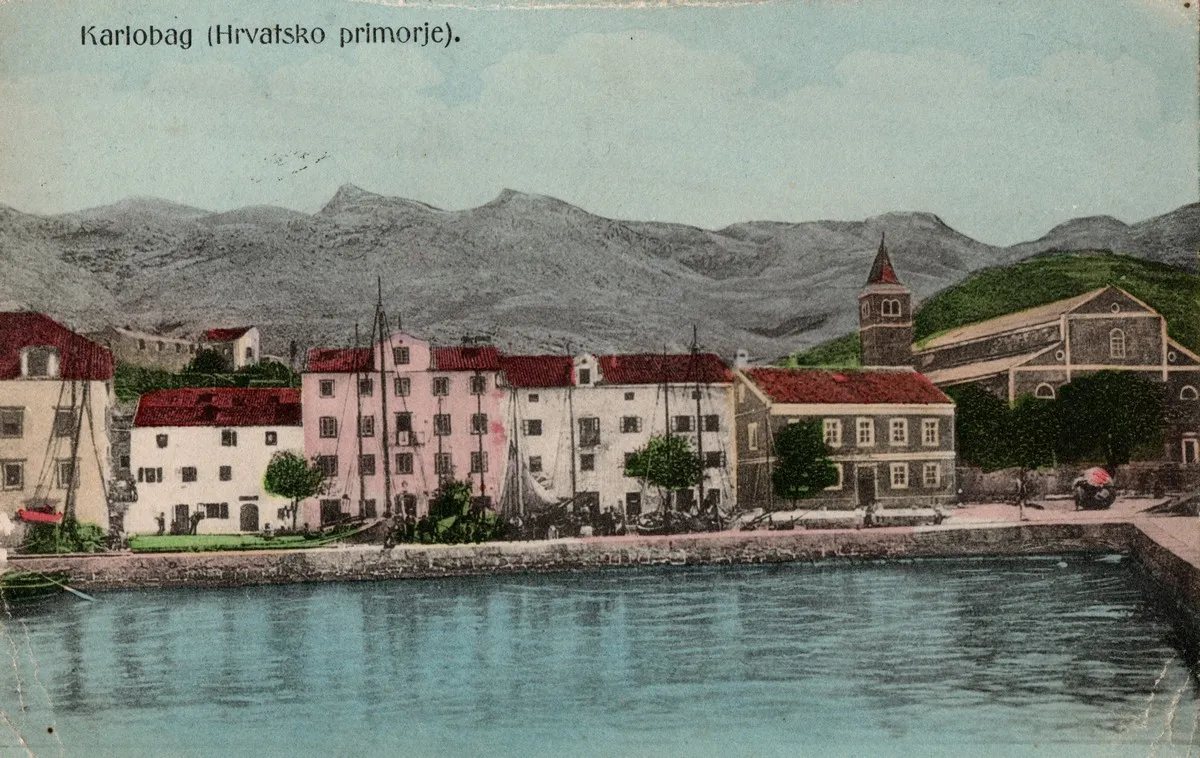
Today, Karlobag preserves the spirit of its past in old postcards, stone houses and the scent of the sea—a living thread connecting past and present.