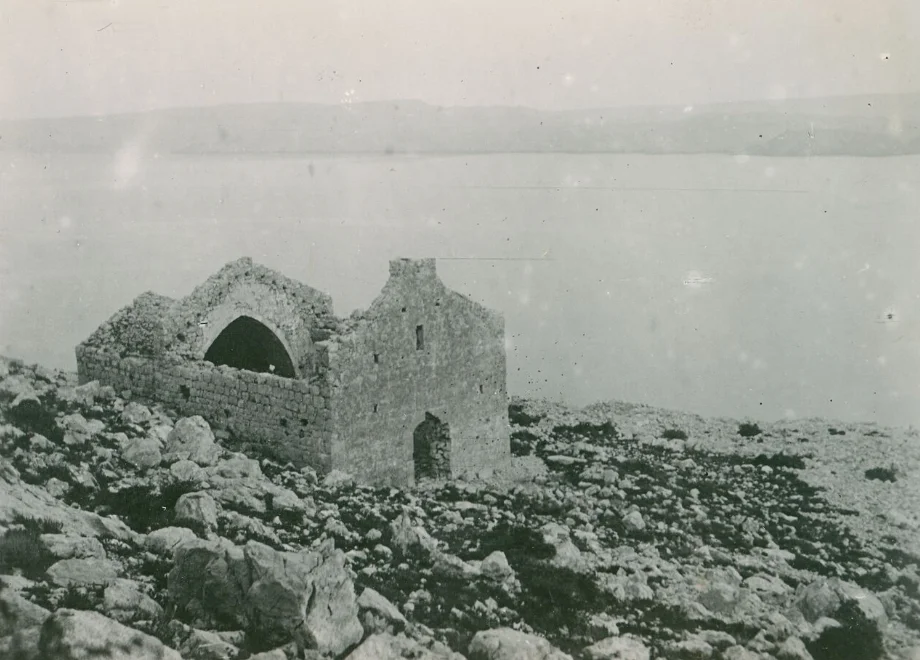
View of St. Vitus Church. The photograph dates from the 1960s.


Centre of Ancient Vidovgrad and the Tribal Parish of Podgorje

High above Karlobag, in the area of Drvišica, lie the remains of St. Vitus Church and a fortified site known as Vidovgrad. Occupying a strategically prominent position overlooking the Velebit Channel and the island of Pag, the site bears witness to a long human presence and to the importance of the high ground above present-day Karlobag.
Archaeological finds and surviving structures indicate that the site was used during several historical periods. Traces of a prehistoric hillfort, Roman-period activity and a medieval fortification show that Drvišica was not chosen by chance. Its natural position enabled control of the surrounding area and of maritime routes through the Velebit Channel.
The site also contains the remains of a church dedicated to St. Vitus, one of the most widely venerated early Christian martyrs. His cult spread throughout much of Europe during the Middle Ages, and churches dedicated to St. Vitus were often built in prominent locations.
Some interpretations also connect the cult of St. Vitus with earlier Slavic beliefs, particularly with Svantovid. Historians and ethnologists have discussed such links in the broader context of the Christianisation of Slavic lands, but they cannot be directly confirmed for Drvišica itself. This layer of the site’s past should therefore be regarded as a possible interpretation rather than an established fact.
For centuries, St. Vitus Church formed part of the sacred landscape of Karlobag and its surroundings. Although it gradually fell into ruin, its remains preserved the memory of a place to which the local population attached particular significance. Devotions, vows and customs associated with the church and the feast of St. Vitus further strengthened the community’s connection with the site.
Today, the remains of the church and Vidovgrad form a valuable part of Karlobag’s historical and archaeological heritage. Within a relatively small area, traces of several periods meet — from prehistory and antiquity to the Middle Ages and later forms of popular devotion.
Drvišica is therefore more than a viewpoint overlooking Karlobag, Pag and the Velebit Channel. It is a place of long historical continuity, where changes in settlement, defence and religious life can be traced among the communities that inhabited this part of the Velebit coast over the centuries.
The remains of St. Vitus Church on Drvišica were documented by specialists as early as the beginning of the 20th century. Archaeologist Josip Brunšmid visited the site in 1900, examined and measured the church, and prepared its ground plan. According to his measurements, the church was 12 metres long externally and 6.86 metres wide, while the walls ranged in thickness from 0.60 to 0.90 metres.
The church was built on sloping rocky ground that had first been cut into and levelled to provide a suitable building platform. It was constructed of squared stone blocks laid in horizontal courses with mortar. During his examination of the site in 1996, Ante Glavičić recorded that the church walls, the façade with part of the bell-gable, and the square apse were still preserved, while fragments of the stone portal were already lying in front of the church.
Another valuable record of the church’s appearance is the ground plan prepared by Većeslav Henneberg on 16 December 1914 at a scale of 1:50. Together with Brunšmid’s earlier measurements and later field observations, the drawing makes it possible to follow the condition and preservation of the church throughout the 20th century.
Source: Ante Glavičić, “Ostatci crkvica sv. Vida u Senju i Karlobagu”, Senjski zbornik, 23, 1996, pp. 41–58.
View of St. Vitus Church. The photograph dates from the 1960s.
Source: Ministry of Culture and Media of the Republic of Croatia, inv. no. MKM-FKB-7835.
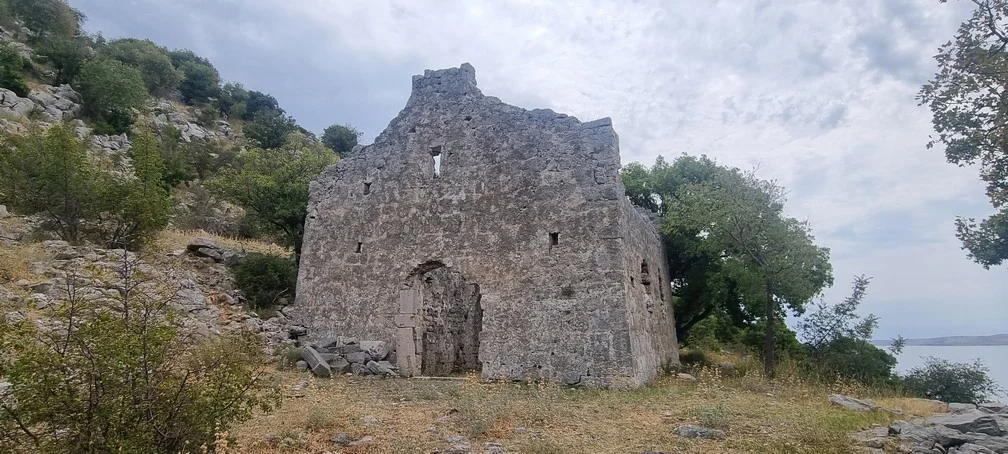
Source: Private archive of Tomislav Potočnjak.
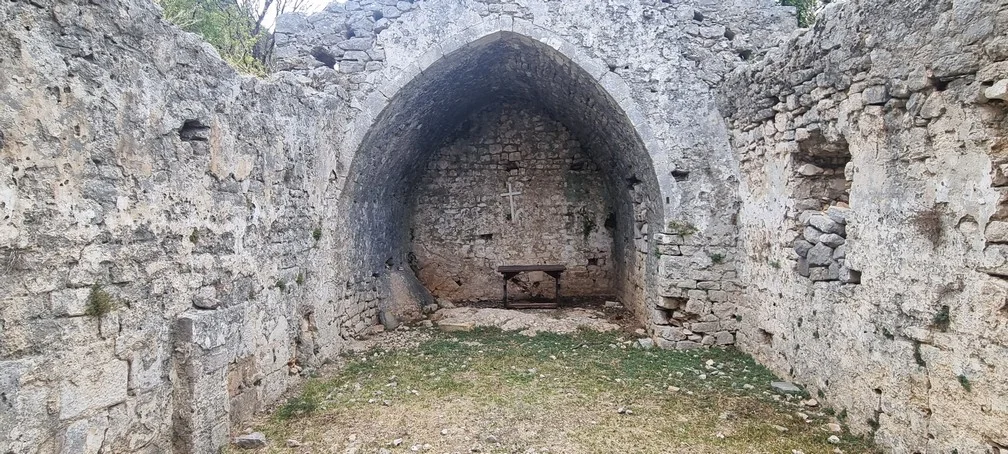
Source: Private archive of Tomislav Potočnjak.
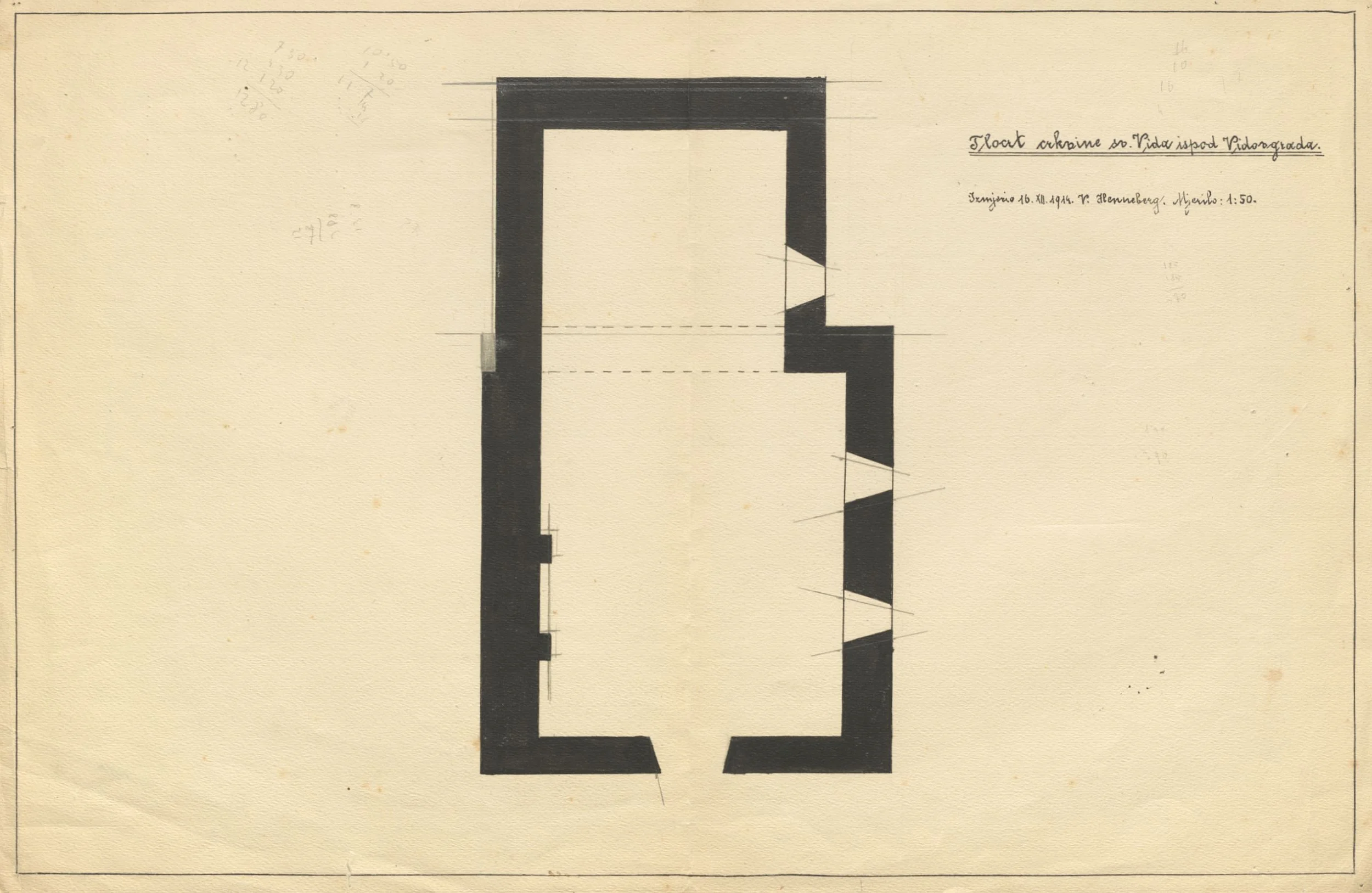
Ground plan of the ruins of St. Vitus Church below Vidovgrad, drawn in ink. The site was measured by V. Henneberg on 16 December 1914. Scale 1:50.
Source: Ministry of Culture and Media of the Republic of Croatia, inv. no. MKM-OVH-29.
A distinctive example of Early Gothic architecture in the Croatian Littoral. The church measures 12 × 7 m and has an irregular square apse and walls that have withstood the bora wind for centuries.
An old administrative centre that lost importance in the 14th century with the rise of the port of Scrissa (Karlobag). From 1322, it was held by the powerful Princes of Kurjaković.
Traces of a Roman-period building constructed from finely dressed stone, together with rich mosaics, confirm the importance of this elevated site since Roman times.
St. Vitus, interpreted as the successor to Svantovid, watches over the channel. Rosaries and flowers can still be found in the crevices of the walls as living traces of popular devotion.
"From Roman mosaics to Gothic walls, every stone on Drvišica preserves the memory of St. Vitus, who ‘sees all’, and of a people who never ceased building beneath the clouds of Velebit."