Virtual corner: Legends, secrets and hidden treasures of Podgorje

Welcome to “Mystical Karlobag” – a virtual corner on the shores of the Velebit Channel, where stone, sea and bora have guarded forgotten stories for centuries. Here, history intertwines with imagination and the oral traditions of the Podgorje region. Through tales passed down from one generation to the next, we invite you on a journey into the past: from enigmatic signs pointing to hidden treasure, through cursed mountain wells and legends of ancient inhabitants, to the historical guardians of Karlobag’s waterfront. Step into the lesser-known, mysterious side of Podgorje and Velebit.
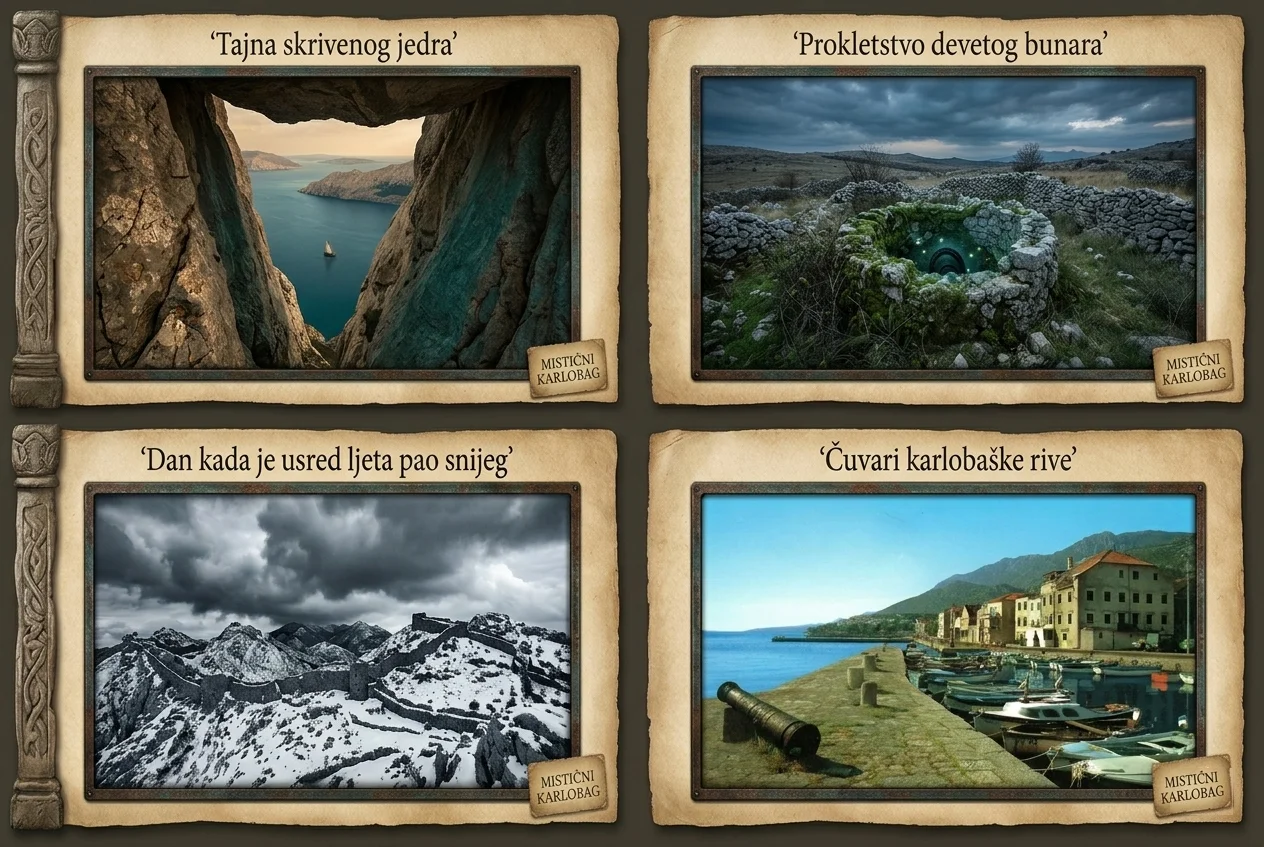
Explore and discover the mysterious side of Karlobag – and help preserve the traditions of Podgorje for future generations.
Among the steep cliffs of the Velebit karst and the deep blue waters of the Velebit Channel lies one of the region’s most unusual legends of buried treasure. In local oral tradition, finding hidden gold did not depend on conventional maps or mere luck – the key was to discover one precisely defined view of the landscape.
The tradition tells of fugitives, kings and wealthy men who hid valuables in caves and rocky hollows. To prevent others from finding their gold, they left secret instructions in writings and old books. The most enigmatic clue required the seeker to find a spot from which the distant sea, framed by a narrow gap between immense rocks, appeared in the shape of a small ship’s sail.
Ethnological field records preserve two locations associated with this unusual sign, where the story was passed down through generations:
The gorge near Vidovac Cesarički (Karlobag):
The tradition tells of an old book once owned by a local man, Nikola Kovačević. It contained precise instructions for finding an earthen pot filled with gold in the karst above Karlobag. The seeker had to reach the gorge and stand on a particular stone slab. From there, he was to look downward until the sea, caught between the rocks, appeared “like a sail on a ship, but the first sail, not the large one”. Only after finding that exact line of sight was he to turn to the right, where the entrance to a hidden cave would appear. The story says that after returning from America, Nikola managed to locate the slab and see the “sail”, but he was too late – the pot had already been removed, leaving only its clear impression in the dust of the cave floor.
Zovine near Stinica (the treasure of King Béla):
A second tradition is linked to the locality of Zovine and the flight of the Croatian-Hungarian King Béla IV from the Tatars. According to stories preserved by local families, the king buried his valuables in a hidden hollow. The clue was again precise: the gold lay at the one point from which the sea, seen through the rocks, resembled a ship’s sail, directly beneath a carved stone shaped like a small pyramid. Local people recalled finding such a pyramid-shaped stone marker, but the secret of the hidden sail at this site was sealed forever when the hollow was blasted and buried beneath tons of rock during construction of the old cableway at Stinica.
Yet the story of the hidden sail lives on. It recalls a time when, in oral tradition, the rugged landscape of Velebit and the sea itself became a kind of living map, legible only to those who knew how to recognise the right sign in nature.
Scholarly source: The locations, testimonies and accounts described here are authentic elements of oral tradition recorded in the scholarly paper “Zakopano blago u usmenoj predaji Podgoraca” (“Buried Treasure in the Oral Tradition of the People of Podgorje”) by Matija Dronjić. The study is based on original ethnological fieldwork in the Velebit coastal region.
If you leave Karlobag and head up into the mountains towards the old ruins known locally as Pod Vidovac, you reach a place where history and oral tradition closely intertwine. Among the remains of late-antique and early Slavic Vidovgrad are eight old wells known throughout the area. Yet for centuries, local people passed down a secret about one final well – the ninth.
According to tradition, the ninth well is not easily found: it is buried, cursed and filled with gold. An old story says that Romans and “Greeks” hid treasure there when they fled the region in panic – some before the advance of the Turks, others before the terrifying Velebit bora. On their way towards Baške Oštarije, they threw all their gold into the depths of the last well and placed a curse upon it.
“Whoever comes first to take it will remain there dead.” This was the old curse recorded among the road workers of Vidovac. People firmly believed that anyone who attempted to touch or uncover the stones would die on the spot.
The gold at the bottom of the ninth well was said to be guarded not only by the curse, but also by a black snake. This was no ordinary animal, but an enchanted girl. According to a story told by the grandmother of local residents, the unfortunate girl could be released from the curse in only one way: in the form of a black snake she had to choose and approach a young man from the area, and he had to allow her to kiss him on the face without recoiling or showing fear.
A similar tale is associated with the nearby field of Kalić near Matešić Pod, where stories also mention Greek walls and a well. There, tradition says, a woman unable to have children cried out in despair: “If only God would let me give birth to a snake!” When she actually gave birth to a snake, the Greeks, terrified, set the entire settlement on fire, while the unfortunate mother wept: “Kalić is burning, and a mother’s heart is aching...”
Old people would end the story with the words: “Who knows – perhaps that snake would be a real girl today!”
These stories are more than simple flights of fancy; they form part of the living memory of Podgorje. Even today, overturned stone slabs from old graves around Vidovac bear witness to treasure-seekers who, despite fear of the black snake and the curse, once risked everything in search of the legendary ninth well.
Scholarly source: The locations, testimonies and accounts described here are authentic elements of oral tradition recorded in the scholarly paper “Zakopano blago u usmenoj predaji Podgoraca” (“Buried Treasure in the Oral Tradition of the People of Podgorje”) by Matija Dronjić. The study is based on original ethnological fieldwork in the Velebit coastal region.
Among the most unusual and widespread traditions of the Podgorje region above Karlobag is the story of a mythical ancient population – the mysterious “Greeks”, believed to have built the local hillforts, dry-stone walls and old wells in distant times. They were remembered as immensely wealthy people, but their centuries-long presence on Velebit was said to have ended in a single day, in the very middle of the warmest season.
According to the stories of older people from Podgorje, the fateful change came in the middle of summer, in June around the feast of St Peter – or, in the wider Lika region, around the feast of St Anne. While people were carrying out their summer work, the sky suddenly darkened and a terrible cold swept down from Velebit. In the midst of the summer heat, an extraordinary heavy snowfall covered the mountain to a depth of more than a metre.
Confronted by this inexplicable sign from the heavens, the “Greeks” panicked, interpreting the midsummer snow as a curse or a warning that the end of the world was near. They decided to abandon the region immediately and forever. Because the snow had blocked all mountain paths, they were forced in the middle of summer to harness oxen to sledges and wooden drags in order to escape.
Fleeing in haste and fear, they could not take their immense wealth with them. Old people said that the fugitives hurriedly hid bars of gold and, in some places, even walled them inside bricks near meadows and forests, hoping one day to return for them.
One of the best-known field traditions concerns the Kućišta meadow on the boundary of the Krasno forestry district, where the Greeks were said to have left gold bars sealed inside bricks. For years they secretly returned and searched for the treasure without success, until a violent storm struck Velebit. The wind uprooted an enormous old beech tree, and its roots tore the hidden bricks from the earth, finally revealing the long-lost gold.
This Podgorje legend of summer snow and the flight of ancient inhabitants has been passed down for centuries. In a vivid, mythical way it expresses the unpredictable and capricious character of Velebit – a mountain where, as the people of Karlobag know well, bora and cold can surprise a traveller even at the height of summer.
Scholarly source: The locations, testimonies and accounts described here are authentic elements of oral tradition recorded in the scholarly paper “Zakopano blago u usmenoj predaji Podgoraca” (“Buried Treasure in the Oral Tradition of the People of Podgorje”) by Matija Dronjić. The study is based on original ethnological fieldwork in the Velebit coastal region.
Older residents of Karlobag still remember the appearance of the waterfront in the 1960s and 1970s. Walking along the shore, one repeatedly encountered unusual, massive iron posts used as mooring bollards. What appeared to visitors as ordinary harbour equipment were in fact authentic historical artefacts – old naval cannon, turned muzzle-down and embedded deep in the stone quay to serve as bollards.
These former guardians of the waterfront recalled an era when Karlobag was a strategic point of great importance, repeatedly exposed to the ambitions of major powers, Uskok vessels, Venetian galleys and Ottoman incursions. Centuries earlier, each of these cannon had thundered either from the defensive walls of Karlobag’s old Fortica fortress or from warships protecting the narrow and turbulent passage beneath Velebit.
When more modern weapons and technology made the old iron obsolete, the people of Karlobag did not simply discard the heavy cannon. Instead, they gave them an entirely new purpose by embedding them in the waterfront. Former symbols of war became sturdy mooring points that for decades held the ropes of local fishing boats and larger vessels, withstanding the strongest blows of the Karlobag bora.
Time and the modernisation of the harbour gradually took their toll, and these historic sentinels disappeared from the waterfront one by one. Yet the past was not completely erased. Modern bollards replaced those that were removed, but the harbour tradition survived through the final example, preserved from oblivion and placed at the very end of the pier, close to the former position of the old guardians.
There, exposed to sea and weather, the cannon has stood proudly for more than sixty years as the harbour’s most recognisable guardian.
Although the old cannon-bollards can no longer be seen in a row along the shore, their story continues to live on. The last cannon at the end of the pier remains a permanent reminder of the ingenuity of local people, who transformed symbols of defence into symbols of the harbour, linking Karlobag’s turbulent past with the mythical Velebit hinterland where old secrets are still said to sleep.
Be the first to like and share the museum.