Fortica above Karlobag was not built by chance, nor was its location chosen for simple practical reasons. Its site is the result of the cold logic of medieval defense and a profound understanding of the landscape. From the elevation above present-day Karlobag, a commanding view opens up over the Velebit Channel, the coastal shipping routes, and the approaches from the Velebit hinterland. Whoever controlled this point controlled the town below.
In the late Middle Ages, when the name Bag first appears in written sources, this area stood at the crossroads of worlds. On one side was the Adriatic coastal belt, focused on trade and maritime life, while on the other lay the mountain paths leading toward Lika and the Croatian interior. It was precisely this dual role—maritime and inland—that made Karlobag strategically important, yet constantly exposed.
Historical sources from the 14th century confirm that Bag was held by the noble Kurjaković family, one of the most powerful aristocratic lineages of medieval Croatia. The Kurjakovićs were not merely local lords; they oversaw key trade and military routes between the coast and the hinterland. In this context, Fortica emerged not as an independent town, but as a defensive extension of Bag—a fortress tasked with surveillance, warning, and protection.
Although the exact date of Fortica's construction is unknown, the surviving remains and the structure of its walls point to the 13th or 14th century, a period of intensive fortification along the Croatian coast. Fortica was a typical medieval stronghold, with massive walls, a simple ground plan, and a position carefully adapted to the terrain. Its strength lay not in its size, but in its strategic location.
Fortica, however, was never a place of lasting security. By the late 15th and early 16th centuries, Ottoman incursions toward the Adriatic turned Karlobag and its fortress into a borderland of constant danger. The town and its stronghold became part of the emerging Military Frontier (Vojna Krajina), a space where borders were not drawn on maps, but on the ground—with every attack, every restoration, and every ruin.
The history of Fortica closely mirrors that of Karlobag: a recurring cycle of construction, destruction, and adaptation. It was not a symbol of permanent rule, but a reflection of the instability of the times in which it was built. Every ruler left their mark upon it, and nearly every war claimed a piece of its walls.
In this context, Fortica is not merely a ruin above the town, but the key to understanding the history of Karlobag—a place that lived on the edge for centuries, always exposed, but never without significance.
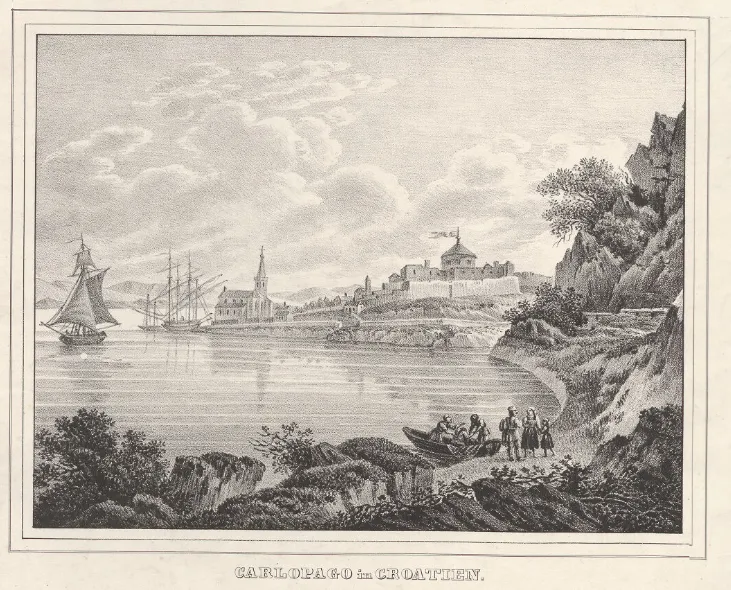
Source: Austrian National Library (ÖNB), Vienna.
The chronology below traces the history of Fortica in greater detail. It follows the site from the period of the Kurjaković family and medieval Bag, through Habsburg Carlopago and the later history of the fortress, to the present day.
Fortica Today
Today, centuries after guards once walked its walls and cannon fire echoed from the stronghold, Fortica has taken on a quieter role.
Although only part of the former fortification survives, its remains still form a distinctive historical landmark above Karlobag.
Today the site is privately owned, and parts of the surviving fortification have been adapted for contemporary use while retaining their historical character.
One part of the site has been arranged as a Mediterranean garden. Instead of gunpowder, the air is now filled with the scents of lavender, immortelle, and rosemary, with views across the Velebit Channel.
During the summer months, another part of the site is also used for cultural and promotional events. The historic walls provide a setting for fashion and art events. The contrast between the surviving fortifications and contemporary design gives these events a distinctive character.
Fortica therefore functions not only as a historical monument, but also as a place where heritage and contemporary cultural activity meet.