HR EN

Fortica Karlobag – Guardian of the Town through the Centuries

History, significance, and the current state of the fortress above Karlobag

Grb Karlobaga
← Home

Fortica above Karlobag was not built by chance, nor was its location chosen for simple practical reasons. Its site is the result of the cold logic of medieval defense and a profound understanding of the landscape. From the elevation above present-day Karlobag, a commanding view opens up over the Velebit Channel, the coastal shipping routes, and the approaches from the Velebit hinterland. Whoever controlled this point, controlled the town below.

In the late Middle Ages, when the name Bag first appears in written sources, this area stood at the crossroads of worlds. On one side was the Adriatic coastal belt, focused on trade and maritime life, while on the other lay the mountain paths leading toward Lika and the Croatian interior. It was precisely this dual role—maritime and inland—that made Karlobag strategically vital, yet permanently exposed.

Historical sources from the 14th century confirm that Bag was held by the noble Kurjaković family, one of the most powerful aristocratic lineages of medieval Croatia. The Kurjakovićs were not merely local lords; they oversaw key trade and military routes between the coast and the hinterland. In this context, Fortica was born—not as an independent town, but as a defensive extension of Bag, a fortress tasked with surveillance, warning, and protection.

While the exact moment of Fortica's construction cannot be precisely dated, archaeological remains and the structure of its walls point to the 13th or 14th century—a period of intensive fortification of Croatian coastal towns. Fortica was a typical medieval fortress: massive walls, a simple floor plan, and a position perfectly adapted to the terrain. Its strength lay not in its size, but in its strategic location.

However, Fortica never knew an era of security. By the late 15th and early 16th centuries, Ottoman incursions toward the Adriatic turned Karlobag and its fortress into a borderland of constant danger. The town and its stronghold became part of the emerging Military Frontier (Vojna Krajina), a space where borders were not drawn on maps, but on the ground—with every attack, every restoration, and every ruin.

The fate of Fortica is therefore the fate of Karlobag: a continuous cycle of construction, destruction, and readaptation. It was not a symbol of permanent rule, but a reflection of the instability of the times in which it was built. Every ruler left their mark upon it, and nearly every war claimed a piece of its walls.

In this context, Fortica is not merely a ruin above the town, but the key to understanding the history of Karlobag—a place that lived on the edge for centuries, always exposed, but never without significance.

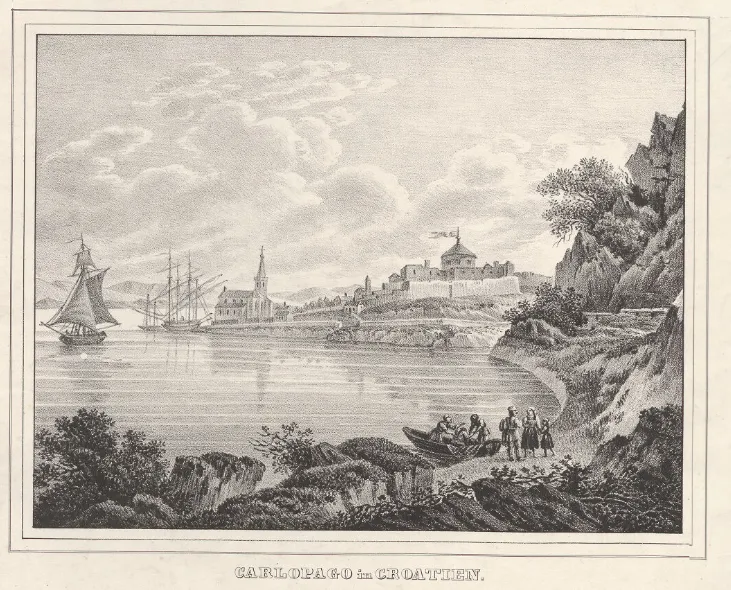
Crtež 3

"Carlopago in Croatien" – A view of the fortified Bag in the 19th century

Old folks in Karlobag used to say that Fortica did not just stand guard against enemies, but that it tamed the Bura wind itself. As the wind from Velebit roared down the slopes, striking the fortress towers, the guards on the walls would say the stronghold was "talking" to the mountain. When the Bura grew too fierce for ships to sail, the fortress became a sanctuary – a safe harbor above the harbor.

Image courtesy of the Austrian National Library (ÖNB) collections in Vienna, used solely for educational and illustrative purposes.

Learn all about the history of Fortica through our detailed chronology. Explore the eras from the time of the Kurjaković family and the medieval towns of Scrissa and Bag, through the significant period of Habsburg Carlopago, up to the role of Fortica in the modern Republic of Croatia.

Period / Year Event Builders / Destroyers Historical Notes
13th Century (likely) Medieval Roots Local Nobility (Kurjaković family) The fortified settlement of Bag (Scrissa) is established, likely with earlier defensive elements under the rule of the Princes of Kurjaković.
14th Century – 1525 Active Defensive Function Princes of Kurjaković Bag plays a vital strategic role as a coastal border point. The fortress serves to defend the settlement and the communication routes between the coast and the interior.
1525 Severe Destruction Ottoman Empire Ottoman forces invade Bag, looting and destroying the settlement and its fortifications. The area remains almost deserted for a long period.
1579 First Major Reconstruction Habsburg Monarchy Archduke Charles II of Styria orders the planned reconstruction of the settlement as a key defensive and port site. The rebuilt town is renamed Karlobag.
1592 Venetian Destruction Republic of Venice General (Proveditor) Almoro Tiepolo conquers Karlobag and systematically destroys it to prevent its growth and eliminate the Uskok pirates.
1617 Peace of Madrid Austria / Venice Following the Uskok War, the Uskoks are forcibly removed from the coast. Karlobag remains under Habsburg rule, but with strict limitations on military and port reconstruction.
1660 Survey and Reconstruction Plan War Council in Graz A military commission led by M. Witzinger and engineer Martin Stier surveys the ruins. Stier creates the famous drawing of the Fortica and proposes modern fortifications.
Late 17th Century Systematic Reconstruction Habsburg Monarchy Based on Stier's plans, the reconstruction of the Fortica begins as a modern bastion fortress. Karlobag regains its role as a key port connecting Lika with the interior.
1693 Administrative Change Royal Chamber (Vienna) Karlobag transitions from military to civil administration under Vienna to promote trade. Nevertheless, the Fortica remains a vital military installation protecting the port.
18th Century Peak of Armament Imperial Military Administration Despite the town's civil administration, the fortress is modernized to its peak. It becomes one of the most heavily armed points in this part of the Adriatic, with over 20 cannons.
1710 – 1714 Major Upgrade Habsburg Military Administration The fortress receives a square layout with four corner bastions and a central structure, with the Fortica finally reaching its definitive architectural form.
1757 Peak of Functionality Antonio Michelazzi (Imperial Engineer) Michelazzi completes a precise blueprint on parchment. The Fortica is a fully organized complex with barracks, a kitchen, and a powder tower (Torre in Terraplano).
1788 Declaration of a Free Port Habsburg Monarchy Karlobag is granted free port status. Town development shifts toward trade and maritime commerce, and the fortifications gradually lose their strategic importance.
1809 – 1813 Napoleonic Occupation French Empire French forces occupy Karlobag and the Fortica. The fortress serves as a major military stronghold within the Illyrian Provinces.
1813 Bombardment and Fall Captain William Hoste (British Navy) The British fleet bombards the Fortica. After capture, the cannons are removed, and the remaining gunpowder is used to mine and heavily damage the fortress.
19th Century (after 1813) Military Abandonment Following the destruction of 1813, the Fortica is no longer rebuilt. Karlobag develops as a commercial hub, and the old fortifications become functionally obsolete.
Today Historical Remains The preserved remains of the walls and bastions stand as a testament to the turbulent military and maritime history of Karlobag.

Fortica Today: A Blend of History, Fragrance, and Style

Today, centuries after the footsteps of guards and the thunder of cannons echoed through the stronghold, Fortica lives a new, more peaceful life. Although its walls are but a shadow of their former power, they still stand proudly as the most prominent "mark of time" overlooking Karlobag.

Its modern destiny is truly fascinating. Now privately owned, its owners have transformed it into a place where past and present meet in the most beautiful way. One part of the fortress has been transformed into a lush Mediterranean garden. Instead of gunpowder, the air is now filled with the scents of lavender, immortelle, and rosemary, creating an oasis of peace with a breathtaking view of the Velebit Channel.

Perhaps the most interesting transformation occurs in the other part of the fortress during the summer months. The ancient walls become a natural backdrop for fashion and art promotion. This fusion of rugged historical architecture and modern design creates an atmosphere that can rarely be experienced elsewhere. Thus, Fortica is no longer just a silent monument to wars, but a vibrant place that celebrates beauty, creativity, and the Mediterranean way of life.

Back

Be the first to like and share us