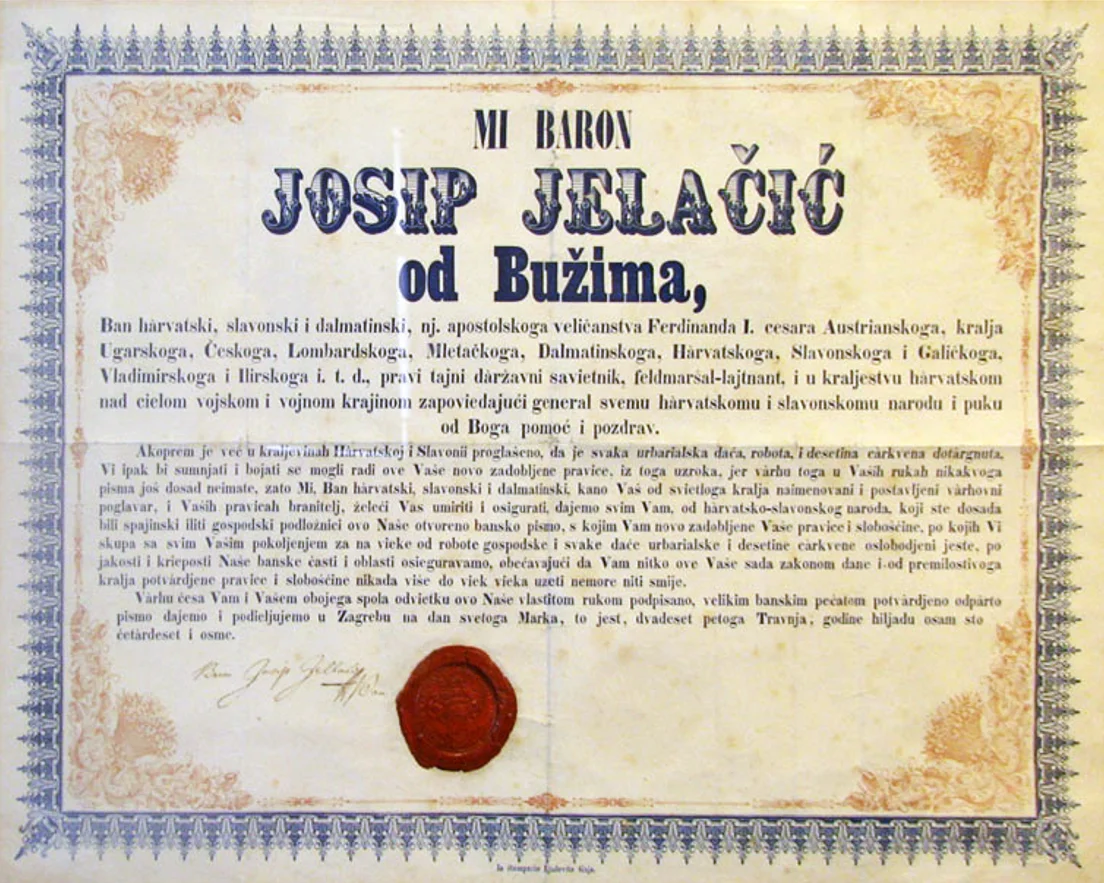


Historical documents, drawings and the Ban’s legacy in the region beneath Velebit
In the turbulent and eventful year of 1851, Karlobag witnessed one of the most significant and ceremonial moments in its modern history. The small town beneath Velebit, then an important port and a centre of the Otočac Regiment of the Military Frontier, welcomed the newly appointed Croatian Ban, Josip Jelačić. This virtual exhibition presents a selection of visual heritage, drawings and proclamations that bear witness to this remarkable historical occasion.
Josip Jelačić was proclaimed Ban of Croatia in Vienna on 23 March 1848 by King Ferdinand, without the knowledge or consent of the Hungarian government. Independently of this decision, the Great National Assembly in Zagreb elected him Ban by acclamation on 25 March. The office of Ban brought with it promotion to the rank of general and command of both Ban’s regiments; on 7 April he was further promoted to field marshal-lieutenant and appointed supreme commander in Croatia and the Military Frontier. Jelačić took the oath of office in Vienna. Upon assuming authority and command over the Military Frontier, he recognised that Europe was in the midst of revolutionary upheaval and that a confrontation with Hungarian hegemonist ambitions was becoming unavoidable. His visit to Karlobag therefore had important military, political and strategic purposes:
Source: Wikipedia.
The Croatian Ban’s arrival was no chance occurrence. It grew out of a determined initiative by local patriots and the military administration, who sought to strengthen the ties between the region beneath Velebit and the rest of Croatia under the Ban’s authority:
Ban Jelačić’s visit carried considerable long-term significance for Karlobag, both politically and economically:
Did you know? The appearance of Karlobag and the character of this period were carefully recorded by noted draughtsmen and cartographers, leaving an invaluable visual record of the region beneath Velebit.
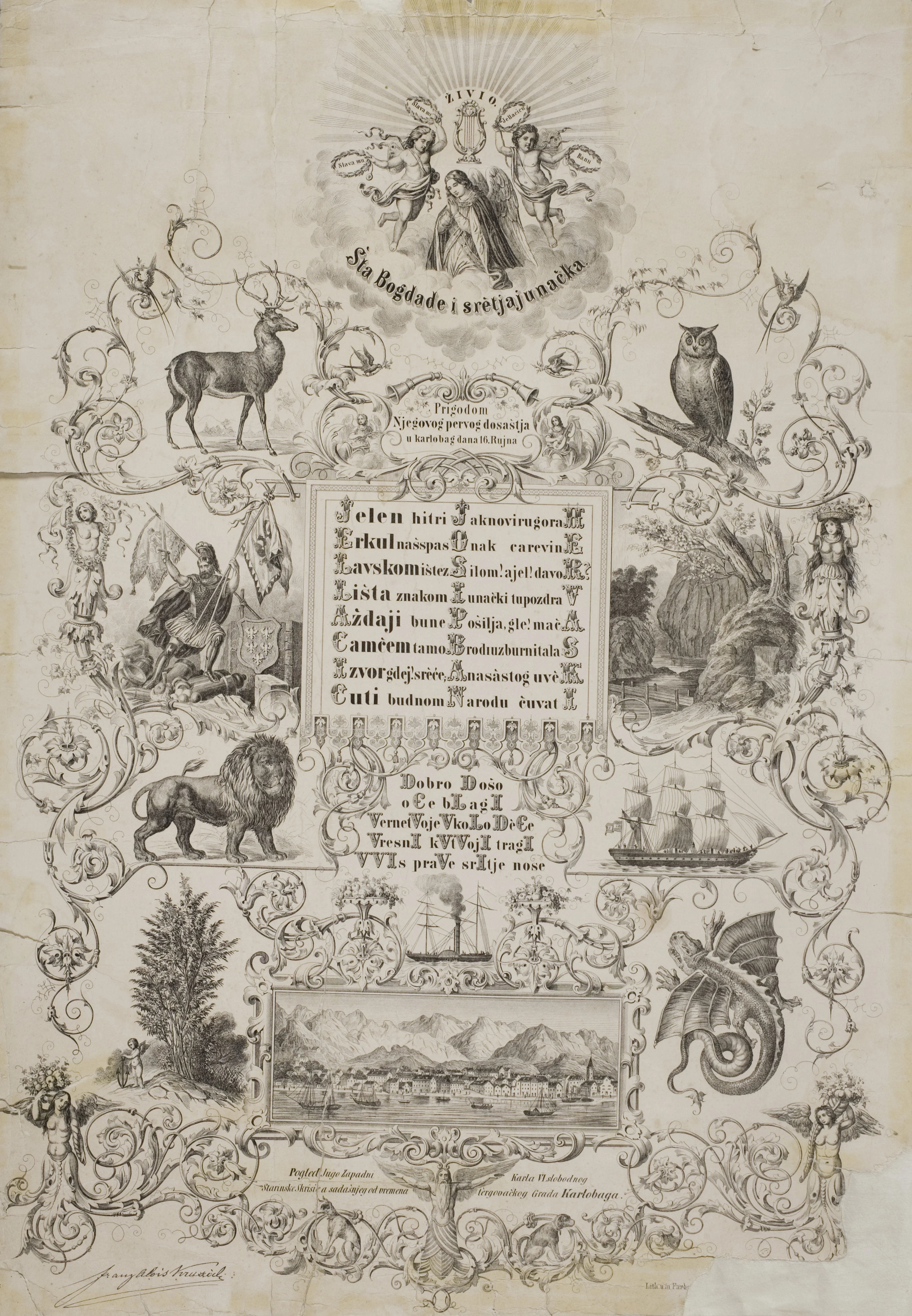
Ceremonial proclamation and acrostic marking the arrival of Ban Jelačić (16 September 1851)
This remarkable document presents an elaborate welcome rich in symbolic imagery — a stag, lion, falcon, dragon and steamship. At its centre is a poetic acrostic whose initial letters, read vertically, spell "JELAČIĆ JOSIP BAN HERVASKI". At the lower left appears the signature of its author, Franjo Vjekoslav Kružić (Franz Alois Kruxich), the soldier and draughtsman who organised the reception, while the panorama along the bottom offers a vivid view of Karlobag’s busy harbour at the time.
Source: Croatian State Archives (HDA), Zagreb.
HR-HDA-903, Graphic Collection of the Croatian State Archives, 16th–20th century, inv. no. 1805.